



2022 China Digital Intelligence Elevator White Paper Released Grandly
On June 18, China's elevator industry reached a historic moment. Midea Building Technologies, together with EO Intelligence, jointly released the 2022 China Digital Intelligence Elevator White Paper (hereinafter referred to as the "White Paper"). This is China's first research white paper targeting the digital intelligence elevator industry. With an innovative perspective and multi-dimensional insights, it provides an in-depth interpretation of the opportunities and challenges facing the current development of the digital intelligence elevator industry, and, through the sharing of typical application scenarios and outstanding cases, showcases digital intelligence elevator system architectures and solutions to global users.
In response to the requirements of the times, the elevator industry is developing from traditional to digital and intelligent
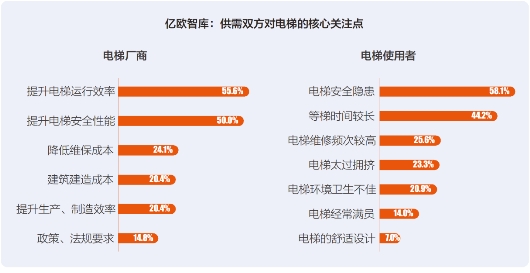
Driven by breakthroughs and innovations in new information technologies such as the Internet of Things, big data, and cloud computing, the global industrial manufacturing industry is rapidly advancing the "Fourth Industrial Revolution" represented by networking and intelligence, and China's manufacturing industry is undergoing comprehensive transformation and upgrading toward intelligence. According to relevant data from the White Paper, nearly 90% of elevator manufacturers believe that the current problem of product homogenization has become an important challenge for the elevator industry. In addition, more than half of users are extremely concerned about the operational safety and efficiency of elevators when using them.
Moreover, as the concepts of smart cities and smart buildings move from the popularization stage into the implementation and construction stage, elevators, as an indispensable and important component of buildings, must respond to the requirements of smart buildings. The development of elevators toward digitalization, intelligence, high efficiency, and low energy consumption has become the general trend. Against this background, "digital intelligence elevators" have emerged.
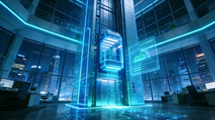
According to the White Paper, digital intelligence elevators specifically refer to the application of digital technology in all links of elevator R&D and design, production and manufacturing, sales management, and installation and maintenance, achieving data connectivity and information interaction and carrying out full-lifecycle management of elevators. On the basis of data collection and information capture, through technologies such as big data, cloud computing, and artificial intelligence, the operating conditions of elevators are intelligently analyzed, and decisions on preventive maintenance, upkeep, and repair are made. Some manufacturers, using the Internet of Things as the underlying foundation and core architecture, have taken the lead in launching the digital, intelligent, and smart upgrading of elevators. With the development of elevators and the extension of IoT capabilities, the industry has derived multiple applications.
With the Internet of Things as the Foundation, the Future Development of Digital Intelligence Elevators Focuses on Five Major Directions
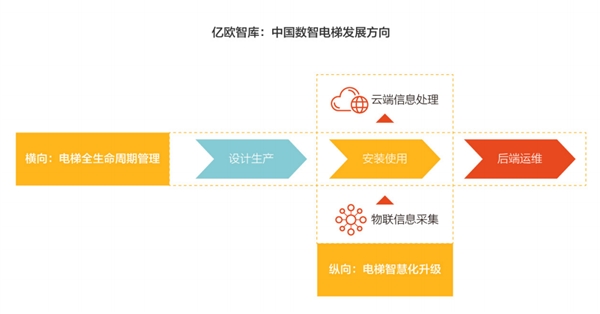
The White Paper points out that, entering a new stage, digital intelligence elevators will take the Internet of Things as their foundation and use a unified digital architecture to integrate data from all links such as elevator production, manufacturing, and use, achieving full-lifecycle management as the horizontal development path; while using sensor devices to strengthen the collection of data such as passenger flow and power during elevator operation, realizing data analysis to assist intelligent decision-making, and, as a key part of smart buildings, achieving interconnection and intercommunication with other systems in the building as the vertical development path. At the same time, they will continue to develop in depth along five major directions:
First, monitor real-time data to improve security levels. As the core issue of greatest concern, elevator safety carries the earliest exploratory application goals of the elevator Internet of Things. Within the logic of digital intelligence exploration, the use of a unified data monitoring system can, for passengers and property owners, achieve functions such as automatic elevator alarms, one-touch emergency calls, and operation to designated floors, effectively improving the safe operation and fault handling capabilities of elevators. For property management and back-end maintenance personnel, it can achieve functions such as real-time elevator monitoring, autonomous early warning, and on-demand maintenance, precisely controlling the operating conditions of elevators and safeguarding safety.
Second, power drive combined with algorithm upgrades to improve elevator efficiency and energy savings. Survey results targeting elevator manufacturers show that among the many core concerns regarding elevators, "improving elevator operation efficiency" ranks first in attention. As important equipment carrying transportation functions in buildings, how to improve elevator operation efficiency and optimize dispatching algorithms while reducing elevator energy consumption is a key focus of R&D in the elevator industry. Digital intelligence elevators provide the possibility of using new information technologies such as big data and cloud computing to achieve intelligent networked control and analysis. During peak elevator use periods such as commuting times and at different time periods, the number and frequency of dispatched elevators can be adjusted according to passenger flow, making elevator scheduling more precise and efficient, improving users' riding experience, and meeting elevator managers' needs for efficiency improvement and energy savings.
Third, firmly grasp the two key points of "safer" and "more convenient" to improve the user experience. The digital and intelligent transformation and upgrading of the elevator industry in the future must ultimately land in practical applications. For passengers, the functional needs when riding elevators have always centered on whether it is safe and whether it is convenient. In the survey of elevator functions that users expect to have, the top five are: elevator fault warning, automatic alarm, shortened waiting time, intelligent detection, and cabin comfort. This undoubtedly puts forward requirements for the elevator industry, with the support of new information technologies and power systems, to accelerate the implementation of practical functions in areas such as security, convenience, comfort, and intelligence, and to more effectively improve users' elevator riding experience.
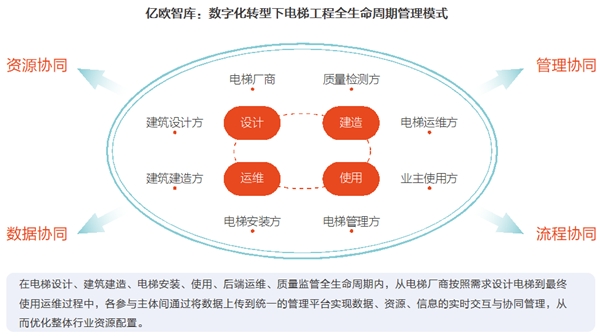
Fourth, from point to area, connect the entire lifecycle of elevators. The entire process of elevators from design to use involves multiple participants, and different participants have different emphases in their demands for elevators. In the past, because each used different management systems, project information flow was slow and the degree of automation was low. In digital intelligence elevators that use data as productivity, a unified data architecture will be used to separately improve the digitalization of single links such as elevator sales (i.e., customized customer needs), design, production, manufacturing, installation, use, and operation and maintenance, while enabling data sources to adapt to different work systems, achieving resource collaboration of information and data among responsible entities in the industrial chain, optimizing industry resource allocation, and achieving full-lifecycle management of elevators.
Fifth, cloud-based governance to connect elevators to smart buildings. The "14th Five-Year Plan" sounded the assembly call to "accelerate digital development and build a digital China," driving smart cities and smart buildings from the concept popularization stage into the implementation and construction stage. Smart buildings contain as many as ten subsystems, with a wide variety of equipment, involving air conditioning and HVAC systems, elevator systems, lighting systems, water supply and drainage systems, and so on. Different subsystems are interconnected through building automation systems to achieve information interaction and transmission. The data of digital intelligence elevators will not only be used in elevator management platforms, but can also connect elevator hardware equipment with building control systems, achieving integrated function optimization while also achieving fully automated control and use of intelligent buildings.
Integration of Hardware and Software: Midea's Digital Intelligence Elevator Solution
How can truly safe, efficient, comfortable, and intelligent elevators be achieved? In the full lifecycle process of digital intelligence elevators from R&D and design to operation, hardware products and technologies serve as the foundation, and an intelligent unified platform is even more necessary as support.
Li Jianguo, General Manager of Midea Building Technologies Elevator Company, stated that in terms of safety, Midea's digital intelligence elevator solution maximizes the prevention of elevator accidents and improves elevator security levels through the combination of a complete machine safety protection system and elevator safety protection design; in terms of convenience and efficiency, it applies advanced traction drive design and edge algorithms to achieve electrical and instrument energy efficiency improvement. In terms of comfort and intelligence, based on edge algorithms, the elevator riding environment can undergo adaptive adjustment management, improving the user's riding experience.
In the digital intelligence elevator solution, products are the hardware foundation, but how to effectively connect the entire elevator business process, achieve intelligent interconnection between different devices, and realize digital management of the elevator's full lifecycle still requires the assistance of a software platform. Meng Tao, President of the Midea Building Technologies Research Institute, believes that Midea's digital intelligence elevators rely on Midea's resource advantages in building technology and digital platforms, integrate elevator hardware equipment with intelligent technology, and build the iBUILDING smart elevator management platform. Based on IoT technology, it achieves real-time monitoring of elevator operating conditions and detection of elevator health conditions. Through big data algorithms, it achieves preventive repair and operation and maintenance of elevators, realizing digital management of the elevator's full lifecycle. In addition, based on iBUILDING, a building interconnection engine has been created, which can link smart elevator calling, elevator car screens, service robots (17.790, -0.91, -4.87%), etc., to realize collaborative and integrated smart building scenarios.
The digitalization of elevators cannot be separated from policy guidance. In this regard, the White Paper also puts forward suggestions for the future development direction of the elevator industry. First, relevant departments and associations need to clarify the formulation standards for the elevator Internet of Things, promote the development of digital intelligence elevators from the top down, and establish industry norms in the future; second, as an important perception system in future buildings, it is necessary to open up the ecosystem and strengthen resource integration among enterprises; third, it is necessary to deepen scenario integration and unlock differentiated elevator functions, so that the digital and intelligent transformation of digital intelligence elevators can land in practical applications.