


Review of Energy Storage Policy Development in 2022
China Energy Storage Network News: In 2022, China rolled out a host of policies to support the development of energy storage. The 14th Five-Year Plan for Energy Development clarifies the status of new energy storage as an independent market entity and its functional positioning, sets practical and feasible development targets, and preliminarily outlines the future development pathway for new energy storage. It helps various central ministries and local governments rationally and orderly advance the deployment of new energy storage construction at the macro level. The Implementation Plan for the Development of New Energy Storage during the 14th Five-Year Plan Period puts forward specific proposals for boosting new energy storage from multiple dimensions including development orientation and supporting measures. The energy storage sector is poised to embrace a promising era. In this favorable context, let us review the development of domestic energy storage policies in 2022.
I. National-level Policies
(I) The 14th Five-Year Plan for Renewable Energy Development defines the development orientation of energy storage
On June 1, 2022, nine authorities including the National Development and Reform Commission (NDRC), National Energy Administration (NEA), Ministry of Finance, Ministry of Natural Resources, Ministry of Ecology and Environment, Ministry of Housing and Urban-Rural Development, Ministry of Agriculture and Rural Affairs, China Meteorological Administration and National Forestry and Grassland Administration jointly issued the 14th Five-Year Plan for Renewable Energy Development (hereinafter referred to as the 14th Five-Year Energy Plan), drawing widespread attention across the industry. The Plan states: promote the large-scale application of other types of new energy storage. Clarify the status of new energy storage as an independent market entity, improve trading mechanisms and technical standards for energy storage to participate in various power markets, and leverage its multiple functions including peak shaving, frequency regulation, emergency backup and capacity support, so as to advance multi-scenario application of energy storage on the power supply side, grid side and user side. Innovate business models for energy storage development, define the pricing formation mechanism of energy storage, and encourage energy storage to provide various regulation services for renewable power generation and electricity consumers. Innovate coordinated operation modes, promote the coordinated development of energy storage and renewable energy in an orderly manner, and raise the consumption and utilization level of renewable energy.
Policy Interpretation: The 14th Five-Year Plan for Energy Development serves as the macro blueprint and general guideline for China’s energy development throughout the 14th Five-Year Plan period. It is also China’s first five-year energy development plan after the proposal of the carbon peaking and carbon neutrality goals. From the perspective of policy orientation, the release of the Plan explicitly defines the status of new energy storage as an independent market entity and its functional positioning, sets practical development targets, and preliminarily depicts the development roadmap for new energy storage. It guides central ministries and local governments to rationally and orderly push forward the construction of new energy storage from a macro perspective.
(II) The Implementation Plan for the Development of New Energy Storage during the 14th Five-Year Plan Period draws the blueprint for new energy storage
On January 29, 2022, the NDRC and NEA jointly issued the Implementation Plan for the Development of New Energy Storage during the 14th Five-Year Plan Period (Fa Gai Neng Yuan〔2022〕No.209, hereinafter referred to as Document No.209). Its main contents are as follows:
Development Targets: By 2025, new energy storage will evolve from the initial commercialization stage to large-scale development and be ready for large-scale commercial application. New energy storage will see markedly enhanced technological innovation capacity, greatly improved independent controllability of core technologies and equipment, a basically complete standard system, an increasingly sound industrial system, and basically mature market environment and business models. Among them, the technical performance of electrochemical energy storage will be further improved, with system costs reduced by more than 30%. New energy storage technologies based on conventional power sources such as steam extraction energy storage for thermal and nuclear power units, as well as hundred-megawatt compressed air energy storage technology, will realize engineering application. Mechanical energy storage technologies such as megawatt-level flywheel energy storage will gradually mature. Breakthroughs will be achieved in long-duration energy storage technologies including hydrogen energy storage and thermal (cold) energy storage. By 2030, new energy storage will achieve full market-oriented development. Its core technologies and equipment will be independently controllable; technological innovation and industrial development will rank among the world’s top. Mature and sound market mechanisms, business models and standard systems will be formed. New energy storage will be deeply integrated with all links of the power system, basically meet the requirements for building a new power system, and fully support the timely delivery of the carbon peaking target in the energy sector.
Accelerate the development of new energy storage on the power supply side: a. Promote the construction of system-friendly new energy power stations: In regions rich in new energy resources such as Inner Mongolia, Xinjiang, Gansu and Qinghai, and other regions with high penetration of new energy, build a batch of system-friendly new energy power stations equipped with properly sized new energy storage. Promote the application of innovative technologies such as high-precision long-timescale power forecasting and intelligent dispatching control to guarantee efficient consumption of new energy and improve the grid-friendliness and capacity support capability of new energy. b. Support the outward transmission of high-proportion renewable energy bases: Relying on existing and newly built inter-provincial and cross-regional power transmission corridors during the 14th Five-Year Plan period, give full play to the role of large-scale new energy storage in Northeast China, North China, Northwest China and Southwest China. Adopt the multi-energy complementary mode of “integrated wind, solar, hydro, thermal and energy storage” to facilitate cross-regional outward transmission and consumption of large-scale new energy, and raise corridor utilization rate and the proportion of renewable electricity. c. Boost the development and consumption of large-scale wind and solar power bases in deserts, Gobi and barren lands: Cooperate with the development of large-scale wind and photovoltaic bases in deserts, Gobi and barren lands, study the configuration technology, reasonable scale and operation mode of new energy storage, and explore the use of renewable energy for hydrogen production to support the outward transmission of large-scale new energy. d. Promote the development and consumption of large-scale offshore wind power: Combined with the development of large offshore wind power bases in Guangdong, Fujian, Jiangsu, Zhejiang, Shandong and other provinces, carry out research on equipping offshore wind farms with new energy storage, reduce the capacity demand of collection and transmission corridors for offshore wind power, and improve the consumption level and capacity support capability of offshore wind power. e. Improve the regulation capacity of conventional power sources: Promote the reasonable configuration of new energy storage for coal-fired power plants and launch demonstration projects of steam extraction energy storage to improve operating characteristics and overall benefits. Explore the application of new energy storage to assist nuclear power in peak shaving, frequency regulation and multi-scenario operation. Explore the use of existing sites and power transmission and transformation facilities of decommissioned thermal power units to build new energy storage or wind-solar-storage facilities.
Develop grid-side new energy storage in light of local conditions: a. Raise the level of safe and stable operation of power grids: Deploy new energy storage reasonably at key grid nodes with concentrated load access, large-scale new energy collection, high-capacity DC feed-in, difficulties in peak shaving and frequency regulation, and insufficient voltage support capacity. Give full play to its multiple functions including peak shaving, frequency regulation, voltage regulation, emergency backup, ramping and black start, as an important measure to enhance the system’s capacity to withstand emergencies and restore after faults. b. Strengthen power supply guarantee in weak grid areas: Reasonably deploy grid-side new energy storage or wind-solar-storage power stations at the grid terminals in remote areas with insufficient power supply capacity such as Xinjiang, Inner Mongolia and Xizang to improve power supply security. In areas not covered by power grids, new energy storage shall support the development and utilization of solar, wind and other renewable energy to meet local energy demand. c. Postpone or substitute investment in power transmission and transformation facilities: Support the construction of grid-side new energy storage in areas with scarce transmission corridor and substation site resources, such as load centers, regions with temporary load growth and areas requiring higher power supply reliability for a certain period. It can postpone or substitute the upgrading and renovation of power transmission and transformation facilities and cut the comprehensive construction cost of grid infrastructure. d. Enhance system emergency support capacity: Build a number of mobile or stationary new energy storage as emergency backup power sources for critical power users including government agencies, hospitals and data centers under the premise of safety and reliability. Study the mechanism for centralized dispatching of energy storage facilities including electric vehicles under extreme conditions to improve the system’s emergency power supply capacity.
Develop user-side new energy storage in flexible and diversified forms: a. Support the construction of distributed energy supply systems: Deploy new energy storage based on distributed renewable energy, microgrids and incremental distribution networks for end users such as big data centers, 5G base stations, industrial parks, highway service areas, and qualified rural users. Explore the application of electric vehicles in distributed energy supply systems to improve energy quality and reduce energy costs. b. Provide customized energy services: Deploy new energy storage for power consumers with high electricity consumption and strict requirements on power supply reliability and power quality in industries including manufacturing, communications, finance and internet, in accordance with the needs of optimized business models and system operation modes, to support high-quality power consumption and improve comprehensive energy efficiency and benefits. c. Enhance users’ flexible regulation capacity: Actively promote the construction of distributed user-side energy storage facilities such as uninterruptible power supplies and charging and swapping infrastructure. Explore and popularize two-way interactive intelligent charging and discharging technologies for electric vehicles and smart power consumption equipment to improve users’ flexible regulation capacity and intelligent and efficient power consumption.
Promote new energy storage to participate in various power markets: Accelerate the development of power medium-and-long-term trading markets, electricity spot markets and ancillary service markets, and enable energy storage to participate in various power markets as an independent entity. Study market access conditions, trading mechanisms and technical standards for new energy storage, and clarify detailed rules for relevant trading, dispatching and settlement.
Improve the ancillary service market mechanism suitable for new energy storage: Promote new energy storage to participate in ancillary services in multiple forms such as independent power stations, energy storage aggregators and virtual power plants. Improve the “payment-by-performance” compensation mechanism for power ancillary services in light of local conditions, enrich ancillary service trading varieties, and launch trading of ancillary services such as reserve and ramping.
Increase support for the “new energy + energy storage” model: In regions with high installed share of new energy and heavy pressure on system peak shaving, actively guide new energy power stations to configure new energy storage through market-oriented approaches. For new energy power generation projects equipped with supporting new energy storage or adopting the shared energy storage model, priority may be given in competitive allocation, project approval, grid connection timeline, guaranteed utilization hours, and assessment of power service compensation in consideration of energy storage technology level and system benefits.
Improve the price transmission mechanism for grid-side energy storage: Determine the development scale of grid-side energy storage reasonably based on the principle of supporting safe, stable and efficient system operation. Establish a capacity price mechanism for grid-side independent energy storage stations and gradually promote their participation in power markets. Scientifically evaluate the benefit of new energy storage in substituting investment in power transmission and transformation facilities, and explore recovering the costs and benefits of grid-substituting energy storage facilities via transmission and distribution tariffs.
Improve pricing mechanisms to encourage user-side energy storage development: Accelerate the implementation of time-of-use electricity pricing policies, establish a critical peak pricing mechanism, widen the peak-valley price gap, guide the transmission of power market prices to the user side, and build a demand response compensation mechanism linked with the electricity spot market to expand revenue channels for user-side energy storage. Encourage users to adopt energy storage technologies to reduce capacity expansion investment for grid connection and give play to the positive role of energy storage in cutting investment in distribution network infrastructure.
Explore and promote the shared energy storage model: Encourage new energy power stations to configure energy storage through self-construction, leasing or purchase, and realize the multi-station sharing function of energy storage. Vigorously support various entities to carry out demonstration of innovative business models such as shared energy storage and cloud energy storage, and pilot the construction of trading platforms and operation monitoring systems for shared energy storage.
Study and carry out aggregated application of energy storage: Encourage the aggregated utilization of distributed user-side energy storage facilities such as uninterruptible power supplies, electric vehicles and charging and swapping facilities. Through the aggregation of a large number of scattered small and micro entities, energy storage can perform peak clipping and valley filling, participate in demand response, and innovate the two-way source-load interaction model.
Innovate investment and operation models: Encourage power generation enterprises and independent energy storage operators to jointly invest in new energy storage projects and allocate benefits reasonably through market-oriented means. Establish a coordinated operation and benefit-sharing mechanism for source-grid-load-storage integration and multi-energy complementary projects. Actively guide social capital to invest in new energy storage projects, and build and improve a fair guarantee mechanism for social capital to develop new energy storage.
Policy Interpretation: The Implementation Plan for the Development of New Energy Storage during the 14th Five-Year Plan Period serves as the macro blueprint and overall guideline for China’s new energy storage development in the 14th Five-Year Plan period. It is also the first dedicated five-year plan and implementation scheme for new energy storage development issued by China at the current stage. The Plan outlines a two-stage roadmap for new energy storage development in China and deploys key tasks in priority areas including technological innovation, pilot demonstration, large-scale development, institutional mechanisms, policy safeguards and international cooperation. It effectively addresses practical issues encountered in the investment and construction of new energy storage projects, guides central ministries and local governments at all levels to push forward new energy storage development, and provides guidance for future sectors for new energy storage deployment. It is worth noting that the Plan does not set a target installed capacity, but prioritizes enhancing technological innovation capability. The non-focus on pure installed capacity targets reflects the country’s emphasis on localized development and market-oriented selection of diverse energy storage technologies, which is more conducive to the sound and high-quality development of the energy storage industry.
In addition, on the policy front, the Plan clearly proposes to accelerate the improvement of the full industrial chain standard system for new energy storage, speed up the formulation of relevant safety standards for new energy storage, further clarify relevant technical standards, and encourage local governments to provide policy support for new energy storage projects in terms of investment and construction, grid connection and dispatching, operation assessment in accordance with local realities. It also promotes the establishment of energy storage development funds to broaden financing channels for new energy storage projects.
(III) The Notice on Further Promoting New Energy Storage to Participate in the Electricity Market and Scheduling Application provides guidance for market participation and scheduling operation of new energy storage
On May 24, 2022, the General Office of the NDRC and the General Department of the NEA jointly issued the Notice on Further Promoting New Energy Storage to Participate in the Electricity Market and Scheduling Application (hereinafter referred to as Document No.475). Its main contents are as follows:
General Requirements: New energy storage boasts advantages including fast response, flexible configuration and short construction cycle. It can perform multiple functions such as peak generation, peak shaving, frequency regulation, ramping and black start in power system operation and constitutes an important component of the new power system. It is necessary to establish and improve market mechanisms adapted for energy storage participation, encourage new energy storage to independently choose to join power markets, adhere to market-based price formation, continuously improve scheduling and operation mechanisms, leverage the technical strengths of energy storage, raise the overall utilization level of energy storage, guarantee reasonable returns for energy storage, and promote the sound development of the industry.
New energy storage may participate in power markets as independent energy storage: New energy storage projects with legal person status, equipped with independent metering and control systems, connected to dispatching automation systems for grid monitoring and dispatching, and complying with relevant standards and requirements of power market operators, may be converted into independent energy storage and participate in power markets as independent market entities. New energy storage projects built as supporting facilities are encouraged to be converted into independent energy storage projects upon technical retrofitting to meet equivalent technical conditions and safety standards. In accordance with the requirements of the Guiding Opinions on Promoting the Integrated Development of Source-Grid-Load-Storage and Multi-Energy Complementarity (Fa Gai Neng Yuan Gui〔2021〕No.280), energy storage within integrated wind-solar-hydro-thermal-storage multi-energy complementary projects shall in principle not be converted into independent energy storage for the time being.
Encourage collocated new energy storage to jointly participate in power markets with its affiliated power sources: For collocated new energy storage projects, upon completion of retrofitting of in-station metering, control and other related systems and meeting relevant technical requirements, they are encouraged to jointly participate in power markets as a whole together with other affiliated power sources in accordance with existing rules. In light of the actual market liberalization of power sources, local authorities are encouraged to support new energy farms and their collocated energy storage to jointly participate in markets, so as to use energy storage to improve the grid-connected performance of new energy and ensure efficient consumption. As market development matures, exploration is encouraged for a market model where one energy storage entity can participate in the market in a mixed mode: part of its capacity operates independently and part operates jointly with power sources.
Accelerate the participation of independent energy storage in power markets to support grid peak shaving: Accelerate the participation of independent energy storage in medium-and-long-term markets and spot markets. Given the relatively small installed capacity of energy storage at the current stage, independent energy storage stations are encouraged to sign market contracts for peak and off-peak periods to deliver peak generation and realize peak shifting and valley filling. Where an independent energy storage station supplies electricity to the power grid, the corresponding electricity consumed for charging shall be exempt from transmission and distribution tariffs, government funds and surcharges.
Give full play to the technical strengths of independent energy storage to provide ancillary services: Encourage independent energy storage to provide ancillary services including active power balance, reactive power balance, emergency response and restoration services, as well as fast active power response during grid faults, in accordance with ancillary service market rules or management detailed rules. Ancillary service fees shall be reasonably shared by relevant grid-connected entities on the generation side and power users in line with the principle of “who provides benefits, who gains; who receives benefits, who bears the costs” as stipulated in the Measures for the Administration of Power Ancillary Services.
Optimize the scheduling and operation mechanism for energy storage: Optimize energy storage scheduling and operation mainly through market-oriented approaches. For collocated energy storage not yet participating in the market, especially new energy collocated energy storage, power dispatching authorities shall establish scientific scheduling mechanisms, and project owners shall strengthen the operation and maintenance of energy storage facilities to ensure safe and stable operation of energy storage systems.
Further support the development of user-side energy storage: Local authorities shall appropriately widen peak-valley price gaps in light of power supply and demand conditions to create room for user-side energy storage development. Based on local realities, local authorities are encouraged to further widen the upper and lower price limits of medium-and-long-term power markets and spot markets, guide end users to actively deploy new energy storage, and expand revenue sources for user-side energy storage.
Establish a pricing mechanism for grid-side energy storage: Local authorities shall strengthen scientific planning and effective supervision of grid-side energy storage, and encourage grid operators to build energy storage facilities at key nodes in response to power system operation needs. Study the establishment of a capacity price mechanism for grid-side independent energy storage stations and gradually promote their participation in power markets; explore recovering costs and benefits of grid-substituting energy storage facilities via transmission and distribution tariffs.
Revise and improve relevant policies and rules: Based on the revised Regulations on the Administration of Grid-Connected Power Operation and Measures for the Administration of Power Ancillary Services, local authorities shall comprehensively coordinate and promptly revise local market rules, implementation rules for grid-connected operation and ancillary service management adapted to energy storage participation, to promote energy storage to play a positive role in peak clipping and valley filling and power quality optimization.
Policy Interpretation: Document No.475 clarifies for the first time at the national level how new energy storage participates in power markets and scheduling operation, and directly addresses issues encountered in market participation including market entity status, electricity pricing, trading mechanisms and scheduling operation mechanisms. Meanwhile, it is the first policy document that fully defines independent energy storage. Document No.475 requires competent departments and local governments to develop energy storage in a market-oriented manner, provide reasonable guidance in energy storage scheduling and pricing mechanisms, and safeguard market fairness. The release of Document No.475 will further accelerate the progress of local authorities in promoting energy storage participation in power market transactions and improve energy storage trading mechanisms.
II. Local-level Policies
(I) The 14th Five-Year Plan for Energy Development of Guangdong Province strengthens support for energy storage
In April 2022, the Guangdong Provincial Government issued the 14th Five-Year Plan for Energy Development of Guangdong Province. It specifies that Guangdong will accelerate the cultivation of emerging industries including hydrogen energy, energy storage and smart energy, and build new energy industrial clusters with differentiated layout. It will promote the demonstration application of advanced energy storage in the power sector, formulate cost recovery mechanisms for energy storage projects, innovate operation models of energy storage projects, strengthen the development of energy storage standard systems and drive industrial development. It will actively develop other innovative energy storage industries such as large-capacity thermal (cold) energy storage and physical energy storage, and promote the clustered development of energy storage manufacturing, scientific research and innovation industrial chains in Guangzhou, Shenzhen, Huizhou and Zhaoqing.
(II) Jiangsu Province promotes demonstration application and large-scale development of new energy storage
On August 1, 2022, the Jiangsu Development and Reform Commission issued the Implementation Plan for the Development of New Energy Storage in Jiangsu Province during the 14th Five-Year Plan Period. It proposes to accelerate the demonstration application and large-scale development of new energy storage in Jiangsu, enhance the regulation capacity of the power system and boost new energy consumption. It prioritizes the development of power supply-side new energy storage and requires the establishment of a “new energy + energy storage” mechanism on the power supply side. For photovoltaic projects unable to build collocated energy storage stations, energy storage capacity can be secured through purchase. Distributed photovoltaic projects are encouraged to build collocated energy storage stations or purchase peak-shaving services. Existing new energy projects are encouraged to add or purchase new energy storage peak-shaving capacity to improve the system-friendliness of existing new energy power stations and enhance the system’s capacity to accommodate new energy power. Coal-fired power plants are encouraged to deploy new energy storage appropriately to improve the frequency regulation performance and operating characteristics of conventional power sources. Applications of new energy storage supporting nuclear power for peak shaving and frequency regulation will be explored. Grid-side new energy storage will be developed in an orderly manner to provide emergency backup for grid faults and postpone or substitute investment in grid projects. Grid-side new energy storage is currently invested, constructed or commissioned by grid enterprises, or procured via service purchase. User-side new energy storage will be developed flexibly. User-side new energy storage facilities are encouraged for aggregated utilization to deliver peak clipping and valley filling, participate in ancillary service markets and demand response, and realize two-way source-load interaction. Demonstration application of new energy storage technologies will be promoted for diversified scenarios including new energy output tracking, new energy consumption, peak shaving, frequency regulation, power supply capacity improvement, emergency power supply guarantee, and postponement of transmission and transformation upgrading. New integrated application scenarios for energy storage will be explored for distributed renewable energy, microgrids, big data centers, 5G base stations, charging facilities, industrial parks and other end users.
(III) Hebei Province plans over 17 GW of independent energy storage projects
On May 20, 2022, the Hebei Development and Reform Commission released the Guidance Plan for the Layout of Grid-Side Independent Energy Storage in the Province and the Interim Guidance Plan for the Layout of Power-Supply-Side Shared Energy Storage in the Province. To meet the peak shaving and frequency regulation needs of Hebei’s power grid, energy storage projects will be prioritized in Zhangjiakou and Chengde of Northern Hebei Power Grid, along the Taihang Mountains and key counties of Southern Hebei Power Grid. In terms of technology, lithium-ion battery and flow battery energy storage projects will be prioritized and moderately deployed. Pilot demonstration of energy storage projects with different technical routes will be supported. Pilot demonstrations of flywheel, compressed air, sodium-ion and hydrogen storage technologies will be first launched in the Zhangjiakou-Chengde area and along the Taihang Mountains, and further promoted after the market operation of projects matures. During the 14th Five-Year Plan period, it is planned to deploy 8 GW of independent energy storage projects in counties including Jingxing, Pingshan and Lingshou in Shijiazhuang; Fuping, Laiyuan and Mancheng in Baoding; Ningjin, Linxi and Nangong in Xingtai; Huanghua, Haixing and Bohai New Area in Cangzhou; Gucheng, Raoyang and Fucheng in Hengshui; and Shexian, Wu’an and Feixiang in Handan. Another 9 GW of independent energy storage projects will be deployed in counties including Zhangbei, Kangbao and Shangyi in Zhangjiakou; Fengning, Weichang and Longhua in Chengde; and Laoting and Yutian in Tangshan.
(IV) Anhui Province promotes the development of electrochemical energy storage
On August 17, 2022, the Anhui Energy Administration issued the Plan for the Development of New Energy Storage in Anhui Province (2022-2025). It specifies that during the 14th Five-Year Plan period, Anhui’s new energy storage facilities will mainly adopt electrochemical energy storage. The province will actively promote the research and application of new energy storage technologies including renewable hydrogen production, compressed air and mechanical flywheel energy storage, and explore new models and business forms such as shared energy storage. By 2025, Anhui will realize the transition of new energy storage from the initial commercialization stage to large-scale development, with the installed capacity of new energy storage exceeding 3 GW. Construction of centralized energy storage stations is encouraged to improve utilization efficiency. New energy power generation enterprises are supported to build independent energy storage stations through self-construction or joint construction in accordance with local conditions and the principle of intensive and high efficiency. Social capital is actively guided to invest in the construction of independent energy storage stations. Various entities are strongly supported to carry out demonstration of innovative business models such as shared energy storage to build an open and shared energy storage ecosystem. New energy power generation enterprises with energy storage configuration needs are encouraged to rent shared independent energy storage stations nearby on a long-term basis. Accelerate the participation of independent energy storage in power markets to support grid peak shaving and discover prices via the market. Explore revenue models of demand response and virtual power plant aggregation. Taking full account of factors including the peak-valley difference rate of the power system, the proportion of new energy installed capacity, system regulation capacity and user affordability, Anhui will improve peak-valley and critical peak pricing policies, widen peak-valley price gaps and raise the return rate for users building energy storage stations. Where an independent energy storage station supplies electricity to the power grid, the corresponding electricity consumed for charging shall be exempt from transmission and distribution tariffs, government funds and surcharges.
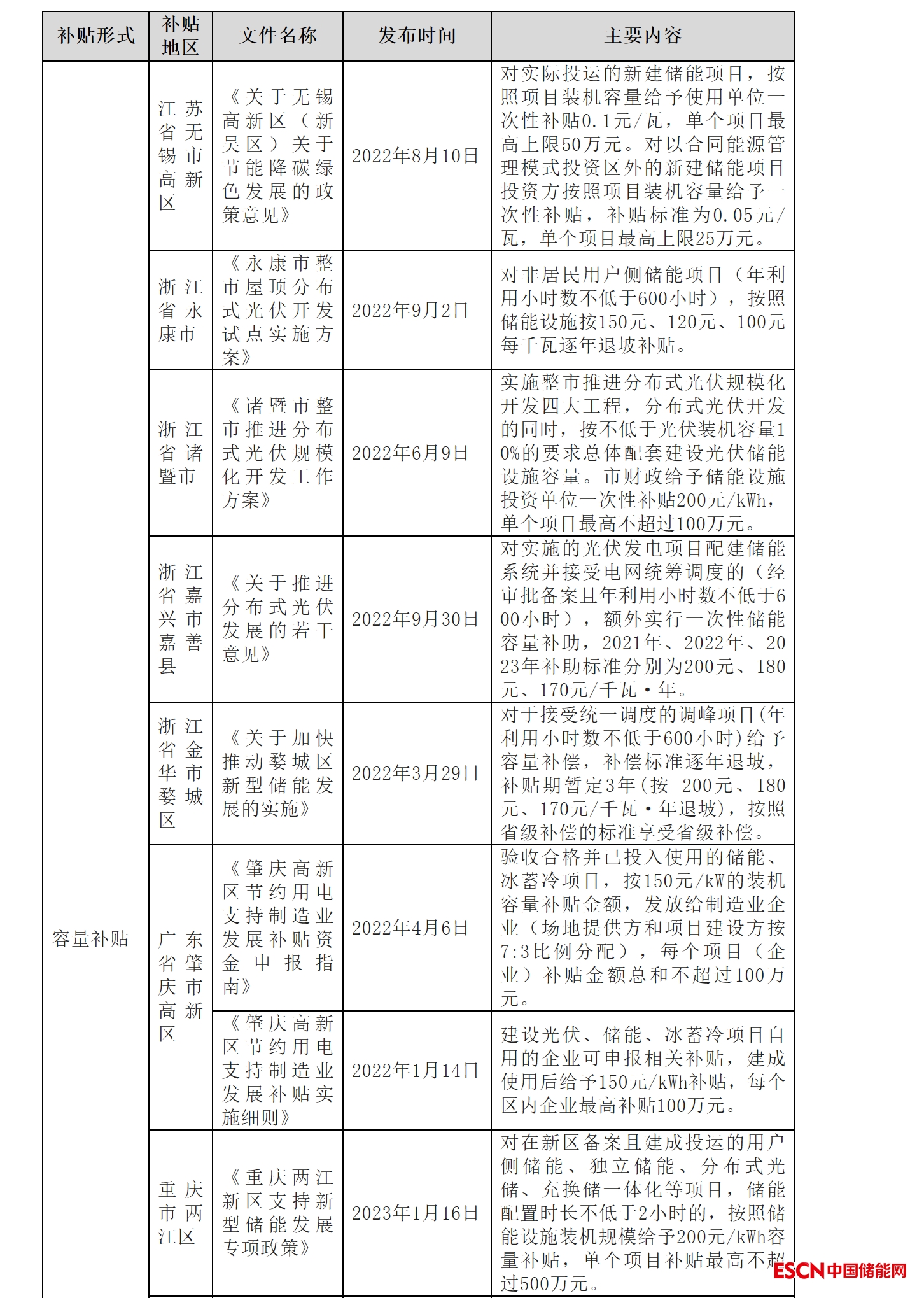
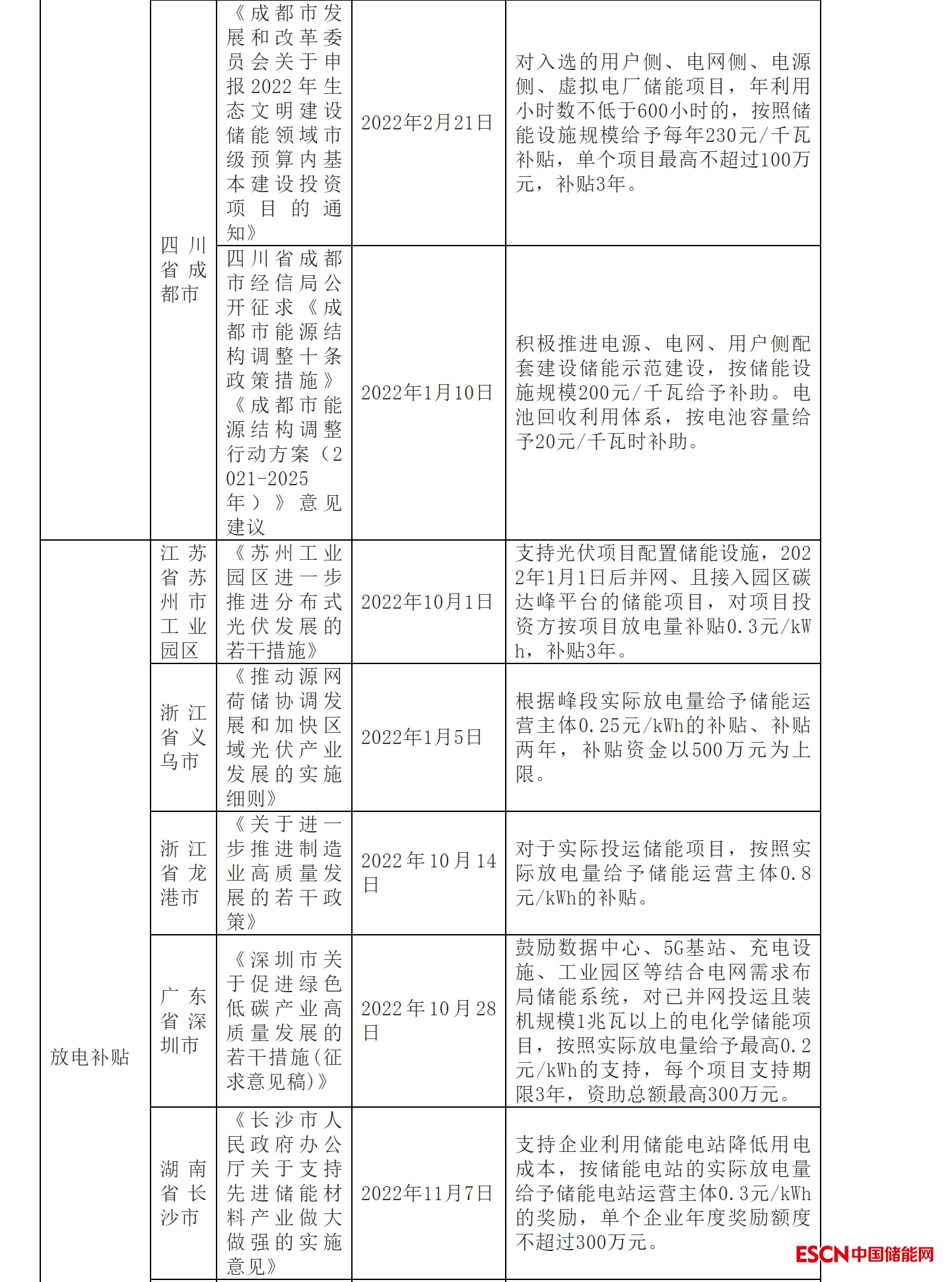
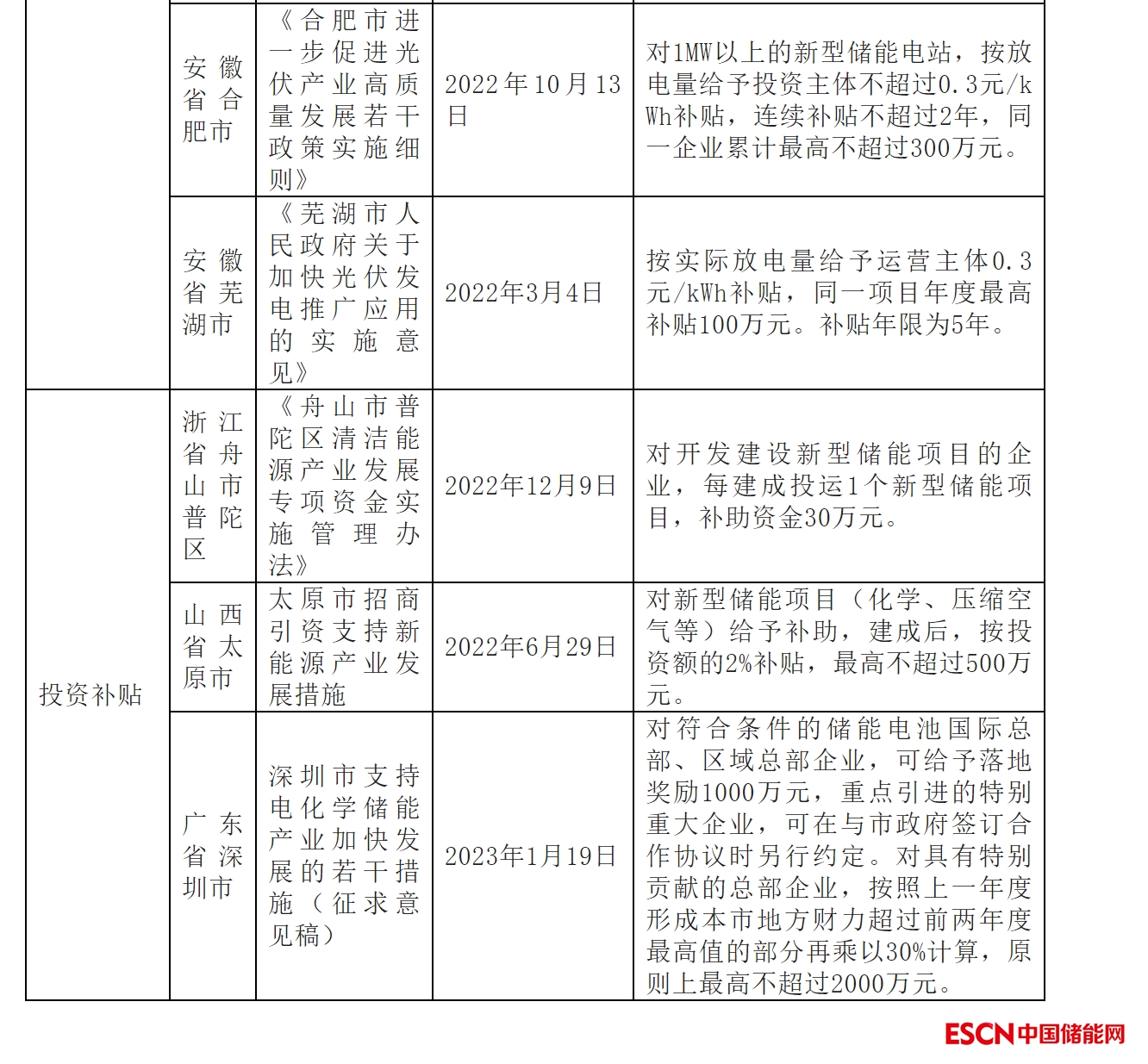
(VII) Local subsidy policies for energy storage in some regions