




"Good Housing + AI" Becomes a New Development Opportunity for China's Elevator Industry in the Era of "Stock Optimization"
“Looking ahead to the next five years, the biggest opportunity for China's elevator industry still lies in urban renewal. Age-friendly renovation, good housing construction, and smart city development—our challenge is how to meet these complex needs with systemic capabilities rather than a single product,” said Peng Dongbin, Vice President of Hitachi Elevator (China) Co., Ltd., at the 17th China International Elevator Exhibition recently held in Guangzhou, Guangdong.
Currently, as the world's largest elevator production capacity country, China's elevator market demand is shifting from "incremental expansion" to "stock optimization," and the after-sales service market is surpassing new elevator installations to become a new core growth pole. Data from the State Administration for Market Regulation shows that the national elevator inventory has exceeded 12 million units, among which more than 1.1 million are old elevators that have been in operation for over 15 years. Demand for installing elevators in old residential communities or renewing old elevators is being released in a concentrated manner.
In 2025, "good housing" was written into the Government Work Report; in 2026, related policies were further deepened, imposing higher requirements on safe, comfortable, green, and smart living environments. Elevators have also gradually transformed from "basic supporting facilities" into an important indicator for measuring living quality.
The average elevator waiting time during peak hours is reduced by 22%, a single elevator saves more than 2,500 kWh of electricity per year, and risk scenarios such as electric vehicles entering elevators, young children riding alone, and pet leashes blocking doors are automatically identified... At the exhibition, the high-quality elevators highlighted by Hitachi Elevator are precisely a new generation of products created around the needs of "good housing."
At the Franz Elevator booth at the exhibition, reporters saw that under simulated abnormal conditions such as cabin entrapment, elderly falls, malfunction-related entrapment, and children entering alone, the Franz system achieves a leap from "passive protection" to "active guardianship" through core technologies such as millimeter-wave radar monitoring, active child locks, intelligent lighting control, and IoT remote response.
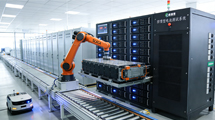
Facing the high-quality demand of the stock market, China's elevator industry is achieving intelligent upgrading across the entire lifecycle through the cross-sector integration of "AI + robotics + digital buildings." For example, in May 2026, UBTECH Robotics signed a cooperation agreement with Hitachi to introduce the industrial-grade humanoid robot Walker S2 into elevator manufacturing sites; on the operation and maintenance side, the cloud service center built by Hitachi Elevator has connected more than 450,000 devices, monitoring elevator operating status in real time through more than 600 AI pre-diagnosis algorithms.
At the exhibition, Luke Elevator Co., Ltd. and Guangdong Xidao Technology Co., Ltd. jointly released the "AI-Empowered Intelligent Elevator Ecosystem Integration Solution," which, relying on a digital-intelligent platform, deeply embeds artificial intelligence into elevator cabins. "The technical system and service platform are highly open, and any complete elevator manufacturer, maintenance company, or community service provider can access them," said Feng Zijü, CEO of Xidao Technology.
In the view of Zhang Lexiang, Secretary-General of the 8th Council of the China Elevator Association, active safety technology created by artificial intelligence is becoming a new architecture for electronic functional safety, and design is also making a leap from function to art. Peng Dongbin believes that the development of smart elevators is no longer limited to a single device itself, and future smart buildings should become "smart life forms" that can perceive, think, have warmth, and evolve.