



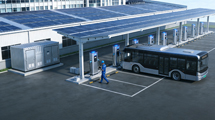

Guangdong to build 217 expressway charging stations by 2020, achieving full coverage in the Pearl River Delta.
Source: Department of Transport of Guangdong Province
In order to implement the relevant work arrangements of the state and the province on accelerating the construction of electric vehicle charging infrastructure, and in accordance with the Guangdong Province Electric Vehicle Charging Infrastructure Plan, the Provincial Department of Transport, together with the Provincial Development and Reform Commission, the Provincial Transport Group, Guangdong Power Grid Co., Ltd., and other organizations, compiled the "Guangdong Province Expressway Charging Infrastructure Construction Plan (2018-2020)" (hereinafter referred to as the "Plan"), which was officially issued recently.
The Plan is based on the level of economic and social development of Guangdong Province and the actual development of new energy vehicles. It follows the principles of "emphasizing connectivity and interconnection; highlighting key points and differentiated development; moderately advancing and linking piles with vehicles; saving land and fully tapping potential." It gives priority to the layout of charging networks along national planned or already built backbone expressways, and simultaneously strengthens the layout of charging facilities along provincial trunk expressways. It focuses on promoting the construction of the charging network in the Pearl River Delta region, while simultaneously accelerating the construction of charging facilities along trunk expressways in eastern, western, and northern Guangdong. It carries out overall coordination from the height of overall development, forming a benign development model of "piles and stations first, vehicles and piles linked." By renovating and installing charging facilities through layout, it reduces construction costs and saves land resources. Newly planned, constructed, or renovated service areas reserve conditions for installing charging facilities in a certain proportion.
The Plan clearly states that by 2020, an intercity charging service network system will be initially built with basically sufficient charging service guarantees, timely and efficient charging and replenishment, and unobstructed travel for trunk-line vehicles. It will achieve interconnection of trunk expressway charging infrastructure between Guangdong Province and neighboring provinces, the Pearl River Delta region, and between the Pearl River Delta and eastern, western, and northern Guangdong. Priority will be given to promoting the construction of the "one vertical, one horizontal, two radiations" national trunk expressways in the province, namely intercity charging facilities supporting service areas along the Beijing-Hong Kong-Macao, Shenyang-Haikou, Changchun-Shenzhen, and Guangzhou-Kunming expressways and expressways in the Pearl River Delta region, while steadily advancing the construction of charging facilities along trunk expressways in eastern, western, and northern Guangdong.
To achieve this goal, the plan is to build 108.5 pairs of expressway intercity fast-charging stations from 2018 to 2020. One pair means construction on both sides of the service area, and 0.5 pair means construction on one side of the service area. The total number of charging stations is 217, of which 89.5 pairs are newly added, with 28.5 pairs built in 2018, 32 pairs in 2019, and 29 pairs in 2020. Among them, 35.5 pairs of charging facilities are planned for national trunk expressway service areas; 40 pairs of charging facilities are planned for expressway service areas in the Pearl River Delta region, achieving full coverage; and 33 pairs of charging facilities are planned for trunk expressway service areas in eastern, western, and northern Guangdong.