




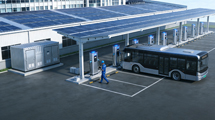



State Council: Promote the Integrated Development of Energy Storage with All Links of the Power System
China Energy Storage Network News: The white paper China’s Actions for Carbon Peaking and Carbon Neutrality, released by the State Council Information Office on November 8, shows that remarkable achievements have been made in China’s green and low-carbon energy transition.
The white paper notes that based on its national conditions and development stage, China has vigorously promoted renewable energy substitution while safeguarding energy security, and advanced the development of a new energy system and new-type power system, providing strong support for achieving the carbon peaking and carbon neutrality goals.
Accelerate the development of new-type energy storage. Energy storage serves as an important foundation for building the new-type power system. China promotes the integrated development of energy storage with all links of the power system. It actively develops "new energy + energy storage", source-grid-load-storage integration and multi-energy complementation. With priority given to key grid nodes and remote areas, China rationally deploys new-type energy storage, and encourages electric vehicles, uninterruptible power supplies and other resources to participate in system peak shaving and frequency regulation. It promotes diversified application technologies including lithium-ion batteries, flow batteries, compressed air energy storage, gravity energy storage and flywheel energy storage. By the end of 2024, the installed capacity of new-type energy storage reached 73.76 GW / 168 GWh, 20 times that of 2020, accounting for more than 40% of the global total installed capacity.
Non-fossil energy has achieved leapfrog growth. The white paper states that adhering to the principle of "establishing before phasing out", China has prioritized the vigorous development of non-fossil energy, delivering the world’s largest-scale and fastest-growing new energy development. The share of non-fossil energy consumption rose from 16.0% in 2020 to 19.8% in 2024, an annual increase of nearly 1 percentage point.
Wind and photovoltaic power generation have achieved leapfrog development. As of the end of August 2025, the installed capacity of wind and photovoltaic power exceeded 1.69 billion kW, more than three times the figure in 2020. They contributed roughly 80% of all newly added power installed capacity since 2020. The share of power generated by wind and solar sources has steadily climbed upward with an annual growth of 2.2 percentage points. Meanwhile, China scientifically coordinates hydropower development and ecological protection, prioritizes integrated hydro-wind-solar development in hydropower construction, develops nuclear power in a safe, orderly and active manner, and speeds up the development of green hydrogen, biomass energy, geothermal energy and marine energy.
The clean and efficient utilization of fossil energy is being accelerated. The white paper points out that China keeps improving the clean and efficient utilization of fossil energy and reasonably controls fossil energy consumption. The proportion of fossil energy consumption dropped from 84.0% in 2020 to 80.2% in 2024. China vigorously promotes clean and efficient utilization and substitution reduction of coal, and continuously advances the green transition of oil and gas development and utilization.
The comprehensive regulation capacity of the power system continues to improve. The white paper says, alongside the large-scale development of new energy, China has greatly boosted the safe operation and risk resilience of the power system. It accelerates the construction of a new-type power system that is clean, low-carbon, safe, adequate, cost-effective, supply-demand coordinated, flexible and intelligent. China advances the integrated development of source-grid-load-storage (power sources, power grids, loads and energy storage) to realize large-scale development and utilization of renewable energy.
China’s Actions for Carbon Peaking and Carbon Neutrality
(November 2025) The State Council Information Office of the People’s Republic of China
Preface
The Earth is the homeland for humanity. Addressing climate change and advancing sustainable development bears on the future of mankind. Since the advent of the industrial civilization, humanity has created enormous material wealth, yet accelerated the extraction of natural resources and disrupted the balance of the Earth’s ecosystem. Deep-seated conflicts between humanity and nature have gradually come to the fore. In recent years, adverse impacts of climate change have become increasingly evident, and the urgency for global action keeps rising.
Striving for carbon peaking and carbon neutrality is a major strategic decision made by China from a high sense of responsibility for human civilization and based on the inherent requirement for sustainable development. General Secretary Xi Jinping has on many important multilateral and bilateral occasions elaborated China’s firm resolve to achieve the carbon peaking and carbon neutrality goals. On September 22, 2020, at the general debate of the 75th Session of the UN General Assembly, General Secretary Xi Jinping solemnly announced that China aims to have CO₂ emissions peak before 2030 and achieve carbon neutrality before 2060. On December 12, 2020, at the Climate Ambition Summit, he announced China’s nationally determined contributions for 2030. On September 24, 2025, at the UN Climate Change Summit, he further unveiled China’s nationally determined contributions for 2035, injecting greater momentum and certainty into global climate governance and fully demonstrating China’s moral commitment as a responsible major country.
China honors its commitments and delivers on its promises. In the five years since its major announcement on carbon peaking and carbon neutrality, China has firmly established and acted on the philosophy that lucid waters and lush mountains are invaluable assets. It has taken forceful actions and made arduous efforts to secure historic achievements in green and low-carbon transition. China has built the world’s most systematic and complete carbon emission reduction policy framework, established the world’s largest and fastest-growing renewable energy system, fostered the world’s largest and most complete new energy industrial chain, realized the world’s largest-scale and fastest promotion of new energy vehicles, contributed roughly one quarter of the world’s newly increased forested area, and become one of the countries with the fastest decline in energy intensity worldwide. It has explored an effective pathway for green and low-carbon development for developing countries and made important contributions to tackling global climate change and advancing humanity’s sustainable development.
The year 2025 marks the 10th anniversary of the adoption of the Paris Agreement. Over the past decade, global climate governance has weathered twists and turns, yet green and low-carbon development has become an irresistible trend of the times. At present, profound changes unseen in a century are accelerating across the world, bringing global climate governance into a new critical phase. Actions speak louder than words. Only solid measures can translate global climate goals into tangible outcomes and protect our shared homeland, the Earth.
This white paper is released to comprehensively introduce China’s major achievements in advancing carbon peaking and carbon neutrality over the past five years, and share its practices and experience in this endeavor.
I. Unswervingly Advancing Carbon Peaking and Carbon Neutrality
China has elevated carbon peaking and carbon neutrality to a national strategy. It has carried out extensive and in-depth carbon peaking initiatives, accelerated the comprehensive green transition of economic and social development, and blazed a path of ecological priority and green low-carbon development.
(1) Carbon Peaking and Carbon Neutrality: An Inevitable Path
Achieving carbon peaking and carbon neutrality is an inherent requirement for China to address prominent constraints on resources and environment and realize sustainable development. Humanity and nature form a community of life, and harmonious coexistence between humanity and nature lays the foundation for sustainable development. Advancing carbon peaking and carbon neutrality shifts economic and social development onto a green and low-carbon track, effectively safeguarding energy security, industrial and supply chain security and food security, and providing solid resource and environmental support for higher-quality and more sustainable development.
It is an inevitable choice for China to follow the trend of technological progress and drive the transformation and upgrading of its economic structure. A new round of technological revolution and industrial transformation is forging ahead at a rapid pace. Advancing carbon peaking and carbon neutrality leverages green transition as a driving force to promote the transformation and upgrading of the economy, energy and industrial structure, boost collaborative innovation and integrated development between traditional and emerging industries, and foster new drivers and strengths for high-quality development.
It is an urgent need to meet people’s growing demand for a sound and beautiful ecological environment and promote harmonious coexistence between humanity and nature. A sound ecological environment is the most basic public good and the most inclusive benefit for people’s wellbeing. Carbon peaking and carbon neutrality entail green and low-carbon transformation of production and lifestyles, helping to resolve ecological and environmental problems at the source, satisfy people’s rising demand for a beautiful environment, and increase people’s sense of gain, happiness and security.
It represents China’s voluntary efforts to fulfill its responsibilities as a major country and advance the building of a community with a shared future for mankind. Faced with climate change, humanity shares a common destiny. As the world’s largest developing country, China will achieve the world’s largest reduction in carbon emission intensity and complete the transition from carbon peaking to carbon neutrality in the shortest time in world history, which requires extraordinarily arduous efforts. This is China’s practical action to uphold multilateralism and demonstrates its firm resolve to build a clean and beautiful world.
(2) Systematically Promoting Carbon Peaking and Carbon Neutrality
As the largest developing country with a population of more than 1.4 billion, China still faces arduous tasks for economic development and improvement of people’s livelihood. Achieving carbon peaking and carbon neutrality is a multi-dimensional, comprehensive and systematic project. In this process, China balances development and emission reduction, the whole and parts, long-term and short-term goals, and government and market roles. It adheres to the following principles:
Unified national planning. China pursues a whole-of-nation approach, strengthens top-level design, takes green and low-carbon development as a clear orientation, and integrates it into all areas and links of national economic circulation. The National Development and Reform Commission of China gives full play to its role in coordinating carbon peaking and carbon neutrality, and works with all regions and departments to steadily push forward related work.
Prioritizing conservation. China puts energy and resource conservation first, implements a comprehensive conservation strategy, continuously cuts energy, resource consumption and carbon emissions per unit of output, vigorously advocates a simple, moderate, green and low-carbon lifestyle, and forms an effective valve for carbon emission control at the source.
Dual-driving by government and market. China leverages both government guidance and market forces, boosts technological and institutional innovation to speed up the green and low-carbon technological revolution. Meanwhile, it deepens reforms in energy and related sectors, gives full play to market mechanisms, and builds effective incentive and constraint systems.
Smooth domestic and international connectivity. China attaches great importance to international exchanges and cooperation, efficiently coordinates domestic and international energy resources, and actively promotes global advanced green and low-carbon technologies and experience. It also advances the development of a fair, reasonable and win-win global climate governance system.
Risk prevention. China acts in light of national conditions and follows the principle of "establishing before phasing out". In the green low-carbon transition, China effectively safeguards energy security, industrial and supply chain security, food security and people’s normal production and daily life, strives to resolve various risks and hidden dangers, and ensures carbon reduction in a safe manner.
(3) Building the Policy System for Carbon Peaking and Carbon Neutrality
To achieve carbon peaking and carbon neutrality goals, China has built the world’s most systematic and complete carbon reduction policy framework — the "1+N" policy system for carbon peaking and carbon neutrality, which clarifies timelines, roadmaps and implementation plans.
The "1" represents the guiding philosophy and top-level design for China’s carbon peaking and carbon neutrality. At the national level, Opinions on Fully, Accurately and Comprehensively Implementing the New Development Philosophy and Doing a Good Job in Carbon Peaking and Carbon Neutrality and Action Plan for Carbon Dioxide Peaking Before 2030 have been issued to systematically plan and deploy carbon peaking and carbon neutrality work. Ten major carbon peaking actions have been arranged, including green and low-carbon energy transition, energy conservation and carbon reduction efficiency enhancement, industrial carbon peaking, urban and rural construction carbon peaking, green low-carbon transportation, circular economy for carbon reduction, green low-carbon technological innovation, carbon sink capacity consolidation, nationwide green low-carbon initiative, and phased and orderly carbon peaking in different regions.
The "N" refers to implementation plans for carbon peaking and carbon neutrality in key industries, sectors and regions. Relevant authorities have rolled out carbon peaking plans for key fields including energy, industry, transportation, urban-rural development, agriculture and rural areas, as well as key industries such as coal, oil, natural gas, steel, non-ferrous metals, petrochemical and chemical, and building materials. Supporting plans have been released for technological support, fiscal support, green finance, green consumption, ecological carbon sinks, pollution and carbon reduction, statistical accounting, standards and metrology, talent training and cadre training. All 31 provinces (autonomous regions and municipalities directly under the Central Government) have issued their local carbon peaking implementation plans.
II. Remarkable Achievements in Green and Low-Carbon Energy Transition
Energy underpins the progress of human civilization, bearing on national economy, people’s wellbeing and national security and stability. Energy activities constitute the primary source of carbon emissions, and green low-carbon energy transition holds the key to carbon peaking and carbon neutrality. Based on its national conditions and development stage, China has vigorously promoted renewable energy substitution while safeguarding energy security, and advanced the development of a new energy system and new-type power system, providing strong support for achieving the carbon peaking and carbon neutrality goals.
(1) Leapfrog Development of Non-Fossil Energy
Adhering to the principle of "establishing before phasing out", China has prioritized the vigorous development of non-fossil energy, delivering the world’s largest-scale and fastest-growing new energy development. The share of non-fossil energy consumption rose from 16.0% in 2020 to 19.8% in 2024, an annual increase of nearly 1 percentage point.
Wind and photovoltaic power generation have achieved leapfrog development. China pursues both centralized and distributed development. It accelerates the construction of large-scale wind and photovoltaic power bases mainly in deserts, Gobi and barren lands, promotes the standardized and orderly construction of offshore wind power, actively popularizes rooftop photovoltaic systems in urban and rural areas, and encourages distributed wind power development in rural regions. As of the end of August 2025, the installed capacity of wind and photovoltaic power exceeded 1.69 billion kW, more than three times the figure in 2020. They contributed roughly 80% of all newly added power installed capacity since 2020. The share of power generated by wind and solar sources has steadily climbed upward with an annual growth of 2.2 percentage points.
Develop hydropower in light of local conditions. Hydropower serves as important clean energy and flexible power source in western China. China scientifically coordinates hydropower development and ecological protection, prioritizes integrated hydro-wind-solar development in hydropower construction. Focusing on major rivers in the southwest, China actively and steadily pushes forward major river basin hydropower projects and develops pumped storage power stations in an orderly manner. As of the end of August 2025, the installed capacity of conventional hydropower stood at approximately 380 GW, and pumped storage installed capacity reached 62.365 GW.
Develop nuclear power in an active, safe and orderly way. Nuclear power is high-quality and efficient clean energy. China consistently develops nuclear power in an orderly manner under the prerequisite of ensuring safety, and promotes nuclear energy applications in clean heating, industrial heat supply and seawater desalination. As of the end of August 2025, China had 112 nuclear power units in operation, under construction or approved for construction, with a total installed capacity of 125 GW, ranking first worldwide. China applies the strictest safety standards and supervision, and its nuclear power safety performance remains among the world’s best.
Accelerate the development of green hydrogen, biomass energy, geothermal energy and marine energy. Driven by innovation, China advances the whole industrial chain of hydrogen production, storage, transmission and utilization, and speeds up the cultivation of new products, new business forms and models. By the end of 2024, China’s annual green hydrogen production capacity exceeded 150,000 tonnes, ranking first globally. China promotes diversified development and utilization of biomass energy in light of local conditions, steadily develops agriculture and forestry biomass power generation, biogas power generation and municipal solid waste incineration power generation, popularizes clean heating using biomass energy, and promotes clean liquid fuels such as bioethanol and biodiesel in an orderly way. As of the end of August 2025, installed biomass power generation capacity reached 46.88 GW, 1.6 times that of 2020. A number of centralized geothermal heating projects have been completed. Demonstration projects for tidal current and wave power generation have been explored, making positive progress in the large-scale utilization of marine energy.
(2) Accelerated Clean and Efficient Utilization of Fossil Energy
China keeps improving the clean and efficient utilization of fossil energy and reasonably controls fossil energy consumption. The proportion of fossil energy consumption dropped from 84.0% in 2020 to 80.2% in 2024.
Vigorously promote clean and efficient utilization and substitution reduction of coal. Based on its resource endowment dominated by coal, China coordinates stable coal supply and low-carbon transition, scales up the construction of green mines and smart mines, and continuously cuts carbon emissions during coal mining. China carries out energy-saving and carbon-revamping for coal-fired power units, and continues to phase out backward capacity in the coal power sector. Over the past decade, China has retired more than 10 GW of backward coal-fired power capacity. It intensifies coal substitution reduction in key industries, raises the proportion of clean energy application and electrification level in industry, and steadily pushes forward the substitution of bulk coal. The share of coal in total energy consumption fell from 56.7% in 2020 to 53.2% in 2024.
Continuously advance the green transition of oil and gas development and utilization. China fully implements green oil and gas production initiatives, promotes the construction of green oil and gas fields, and advances the transformation and upgrading of the oil refining and chemical industry to realize energy conservation and carbon reduction in production. It increases the substitution of traditional fuel oil by advanced bio-liquid fuels and sustainable aviation fuels. A special campaign for oil product quality upgrading has been implemented, achieving three consecutive upgrades from National Standard III to National Standard VI. China finished in less than 10 years what developed countries took nearly 30 years to accomplish, effectively reducing pollutant emissions from vehicle exhaust.
(3) Continuous Improvement in Comprehensive Regulation Capacity of the Power System
Alongside the large-scale development of new energy, China has greatly boosted the safe operation and risk resilience of the power system. It accelerates the construction of a new-type power system that is clean, low-carbon, safe, adequate, cost-effective, supply-demand coordinated, flexible and intelligent. China advances the integrated development of source-grid-load-storage (power sources, power grids, loads and energy storage) to realize large-scale development and utilization of renewable energy.
Enhance the capacity for coordinated and optimized operation of power sources. China gives full play to the flexible regulation capacity of coal-fired power units and fully implements flexibility retrofitting for coal-fired power units. More than 50% of coal-fired power units are capable of deep peak shaving. China builds gas peak-shaving power stations in light of local conditions, rationally deploys pumped storage and concentrating solar power, and speeds up the large-scale application of new-type energy storage technologies. It continuously optimizes the multi-energy complementary dispatching and operation mode on the power source side, fully taps peak shaving potential, and steadily improves the safe operation and comprehensive regulation capacity of the power system.
Strengthen mutual complementation and support of power grids. China innovates power grid structure and operation modes, improves grid intelligence, and pushes grids to actively adapt to large-scale centralized new energy and widely distributed energy resources. It improves the main grid framework to consolidate the physical foundation for power system stability, forming a pattern of six interconnected regional power grids. The capacity for cross-provincial and cross-regional power allocation keeps rising. In 2024, the cross-regional power transmission volume reached 924.7 billion kWh and cross-provincial power transmission hit 2 trillion kWh, up 50% and 30% respectively compared with 2020. China accelerates the retrofitting and upgrading of distribution networks to raise their capacity to accommodate new energy power. It actively develops smart microgrids mainly for consuming new energy, achieving compatibility and complementation with the bulk power grid.
Greatly boost the flexibility of power loads. China systematically integrates demand response resources, guides users to optimize power storage and consumption patterns, and fully unlocks the flexibility of residential and general industrial and commercial loads. Given the high proportion of industrial power consumption, China guides large industrial loads to participate in the ancillary service market, enhances power demand response capacity, and effectively improves power system flexibility. By 2025, China will lift power demand response capacity to 3%–5% of the maximum power load, reaching around 5% in East China, Central China, South China and other regions.
Accelerate the development of new-type energy storage. Energy storage serves as an important foundation for building the new-type power system. China promotes the integrated development of energy storage with all links of the power system. It actively develops "new energy + energy storage", source-grid-load-storage integration and multi-energy complementation. With priority given to key grid nodes and remote areas, China rationally deploys new-type energy storage, and encourages electric vehicles, uninterruptible power supplies and other resources to participate in system peak shaving and frequency regulation. It promotes diversified application technologies including lithium-ion batteries, flow batteries, compressed air energy storage, gravity energy storage and flywheel energy storage. By the end of 2024, the installed capacity of new-type energy storage reached 73.76 GW / 168 GWh, 20 times that of 2020, accounting for more than 40% of the global total installed capacity.
III. In-Depth Advancement of Low-Carbon Development in Key Sectors
Industry, transportation, construction and residential life are major sources of carbon emissions and exert important impacts on carbon peaking and carbon neutrality. China incorporates carbon peaking and carbon neutrality into the overall economic and social development, and speeds up the formation of green and low-carbon production and lifestyles, injecting strong green momentum into high-quality development.
(1) Accelerated Low-Carbon Transformation of Industries
China vigorously promotes collaborative innovation and integrated development between traditional and emerging industries, optimizes and upgrades industrial structure, and boosts the development of green and low-carbon industries, continuously lifting the green and low-carbon level of industries.
The green transition of traditional industries continues to deepen. China firmly curbs the blind launch of high-energy-consuming, high-emission and low-efficiency projects, continuously updates binding standards for environment, energy efficiency, water efficiency and carbon emissions in key sectors, and phases out backward production capacity in accordance with laws and regulations. It promotes green and low-carbon upgrading of key industries, builds benchmarks for green manufacturing, actively carries out clean energy substitution, supports qualified regions to take the lead in building a number of zero-carbon parks, pushes forward the construction of eco-industrial parks, and accelerates low-carbon raw material substitution and recycled resource utilization. In 2024, China’s output of recycled non-ferrous metals reached 19.15 million tonnes, ranking first globally for 15 consecutive years. One tonne of every four tonnes of electrolytic aluminum was produced using green power.
The development advantages of green and low-carbon industries keep strengthening. China continuously fosters new growth points for green and low-carbon economy, and the share of green and low-carbon industries in total economic output keeps rising. China has built the world’s largest and most complete clean energy industrial chain. The "new three items" — new energy vehicles, lithium batteries and photovoltaic products — have become new business cards of Chinese manufacturing. In 2024, the "three new" economy (new industries, new forms of business and new business models) accounted for more than 18% of China’s GDP. The value-added of high-tech manufacturing made up 16.3% of the industrial enterprises above designated size, 1.2 percentage points higher than 2020.
Digitalization and greenization advance in tandem. China gives full play to the positive role of digitalization in improving resource efficiency and environmental benefits, and deepens the application of artificial intelligence, big data and cloud computing in power systems, industrial and agricultural production, transportation, building construction and operation. It promotes the green and low-carbon development of data centers, coordinates the construction of large wind-solar bases and national computing hub nodes, and raises the proportion of green power consumed by data centers. A total of 246 data centers have been selected as national green data centers, with more than half of their electricity consumption from green power.
(2) Accelerated Improvement of Clean and Low-Carbon Transportation System
China vigorously develops low-carbon transport equipment, continuously optimizes transport structure, and speeds up the formation of a modern comprehensive transportation system that is safe, convenient, efficient, green and economical.
Low-carbon transport vehicles are rapidly popularized. China accelerates the promotion of new energy vehicles, achieving the world’s fastest and largest-scale application of new energy vehicles. In January–September 2025, the domestic market penetration rate of new energy passenger vehicles reached 52.2%, ranking first among major economies. China’s railway electrification rate leads the world, reaching 76.2% in 2024. China promotes the adoption of clean power for ships and aircraft. In 2024, the fuel efficiency of China’s civil aviation transport fleet decreased by 20.5% compared with the 2005 baseline level. China further promotes shore power use for ships at berth in key regions, routes and ports. The shore power coverage rate of key specialized berths at major ports exceeds 90%. The electrification level within civil aviation airports in China is leading globally. By the end of July 2025, electric vehicles accounted for 32% of all ground vehicles in civil aviation airports.
Transportation structure continues to be adjusted and optimized. China keeps improving national railway, highway and waterway networks, and promotes rational division of labor and effective connection among different transport modes. It vigorously develops the "one order, one container" multimodal transport, and continuously raises the share of bulk cargo transported by railway and waterway. In 2024, the freight turnover of railway and waterway increased by 17.5% and 33.6% respectively compared with the end of the 13th Five-Year Plan period. The green transportation ratio (via railway, waterway, enclosed belt conveyors and new energy vehicles) of coal and iron ore at major coastal ports reached 88.4%.
Green transport infrastructure keeps upgrading. China actively carries out green upgrading of transport facilities, vigorously develops green highways and waterways, raises the green and intelligent level of newly built stations, airports, docks and other facilities, and strengthens the construction of new energy infrastructure in the transport sector. China has built the world’s largest charging network with the widest vehicle coverage and broadest geographical reach. As of the end of August 2025, the total number of charging infrastructure for electric vehicles in China had accumulated to 17.348 million, 10 times that of five years ago. China fully implements the strategy of prioritizing urban public transport and accelerates the building of a green travel system. By the end of June 2025, 330 urban rail transit lines were in operation with a total mileage exceeding 11,000 km, ranking first globally.
(3) Improved Quality of Green and Low-Carbon Development in Urban and Rural Construction
China accelerates the transformation of urban and rural development models, continuously lifting the green low-carbon level of urban-rural construction and the quality of human settlements.
The low-carbon transition of urban-rural planning and construction speeds up. China gives full play to the guiding role of green and low-carbon planning, integrates green and low-carbon concepts into all links of planning, construction and management, continues to carry out urban renewal actions, and strives to restore urban ecosystems. It promotes green construction methods, develops prefabricated buildings and applies green building materials. In 2024, the newly started prefabricated building area reached 672 million square meters, accounting for more than 30% of newly built buildings. By the end of June 2025, certified green building materials exceeded 10,000 products. China enhances urban climate resilience, improves urban ecosystems, reserves enough ecological space for urban rivers and lakes as well as flood control and drainage space. A total of 90 sponge cities and 39 climate-resilient cities have been piloted. By the end of 2024, the green coverage rate of urban built-up areas reached 43.49%, and the per capita urban park green space area hit 15.91 square meters.
Building energy efficiency has greatly improved. China continuously raises standards for building energy efficiency, vigorously develops green buildings, and carries out energy-saving retrofitting of existing buildings. In 2024, newly built green buildings in cities and towns accounted for 97.9% of all newly built urban and rural buildings that year. During the 14th Five-Year Plan period, China pushed forward energy-saving retrofitting of existing urban and rural buildings. The energy efficiency of renovated public buildings generally rises by 20%. By the end of 2024, energy-saving buildings accounted for more than 66% of the existing urban building stock.
Building energy consumption is becoming increasingly clean and low-carbon. China continuously raises the electrification level of end-use energy consumption in buildings, promotes building-integrated photovoltaic applications in light of local conditions, and popularizes clean and low-carbon heating technologies including heat pumps, biomass energy, geothermal energy and solar energy, effectively cutting carbon emissions in the building sector. In 2024, electricity consumption in buildings accounted for more than 55% of building energy consumption. China actively promotes clean heating in northern China. More than 40 million households in rural northern areas have completed clean heating retrofitting. By the end of 2024, the clean heating rate in northern China reached 83%, nearly 20 percentage points higher than in 2020.
(4) Green and Low-Carbon Lifestyles Become New Trend
China thoroughly implements the nationwide green and low-carbon initiative, and simple, moderate, green, low-carbon, civilized and healthy lifestyles have become the conscious choice of more people.
Green and low-carbon lifestyles are taking shape rapidly. China advocates green and low-carbon concepts and lifestyles, actively guides and promotes the implementation of codes of conduct for citizens on ecological environment, and advances green life creation campaigns. The proportion of residents choosing green and low-carbon travel keeps rising. At present, around 200 million passenger trips are made via public transport each day, and about 25 million trips by shared bicycles. China fully implements domestic waste classification. By the end of 2024, waste classification facilities covered 98.5% of residential communities in prefecture-level and above cities. China explores and promotes the carbon inclusion mechanism. 27 provinces have issued relevant carbon inclusion policies covering green travel, electricity conservation, waste recycling and garbage classification.
Green and low-carbon consumption expands comprehensively. China continuously increases the supply and quality of green and low-carbon products, thoroughly implements the campaign of trade-in for consumer goods, gives play to the dual role of green and low-carbon consumption in driving economic growth and carbon reduction, and guides and encourages the use of green and low-carbon products. Meanwhile, China firmly curbs extravagance, waste and unreasonable consumption, launches the "Clear Your Plate" campaign to reject food waste, guides the public to save water and electricity and reduce the use of disposable products.
IV. Full Implementation and Effectiveness of Key Carbon Reduction Pathways
Energy conservation is a vital measure to cut carbon emissions at the source. Circular economy greatly facilitates carbon reduction, and ecosystem carbon sinks constitute an important way to achieve emission reduction and carbon sequestration. China has thoroughly implemented the energy conservation, carbon reduction and efficiency enhancement initiative, circular economy for carbon reduction initiative, and carbon sink capacity consolidation initiative, achieving positive results.
(1) In-Depth Implementation of Energy Conservation, Carbon Reduction and Efficiency Enhancement Initiative
China adheres to the principle of prioritizing energy conservation, promotes the energy consumption revolution, and strives to build an energy-conserving society. After deducting energy used as raw materials and non-fossil energy consumption, China’s energy consumption per unit of GDP dropped by 11.6% cumulatively in the first four years of the 14th Five-Year Plan period.
Energy conservation management capacity has improved markedly. China continuously improves laws, regulations, standards and policies on energy conservation, forming a mature and effective energy conservation management system. It establishes and improves systems including energy conservation review for fixed asset investment projects. Since 2020, China has carried out industrial energy conservation supervision on more than 20,000 enterprises and conducted energy-saving and carbon reduction diagnosis for over 12,000 enterprises and industrial parks. It clarifies energy conservation management requirements for key industries and enterprises, and pushes major energy-consuming entities to implement refined energy management. China actively promotes market-based mechanisms such as energy performance contracting to boost enterprises’ internal motivation for energy conservation and efficiency improvement. At present, the total output value of the energy-saving service industry exceeds 500 billion yuan, and the newly added investment in energy performance contracting exceeded 170 billion yuan in 2024.
Key energy-saving and carbon reduction projects have been fully implemented. China carries out energy-saving and carbon reduction retrofitting in key industries, improves refined energy management and taps systematic potential for energy conservation and carbon reduction. It implements energy-saving and carbon reduction projects in industrial parks to optimize energy systems and cascade utilization. A total of 491 national green industrial parks have been cultivated, whose energy consumption per unit of industrial added value is two-thirds of China’s average level.
Breakthroughs have been made in energy saving and efficiency improvement of key equipment. China accelerates the promotion and application of advanced and high-efficiency energy-saving equipment. Through the large-scale equipment renewal campaign, more than 20 million sets of equipment in key sectors were renewed in 2024, generating energy savings equivalent to approximately 25 million tonnes of standard coal. China raises energy efficiency standards for key equipment including motors, fans, pumps, compressors, transformers, heat exchangers and industrial boilers. By the end of 2024, energy efficiency labels covered 44 categories of energy-consuming products across five major energy-consuming fields, basically covering all key energy-consuming products and equipment.
(2) Remarkable Carbon Reduction Benefits from Circular Economy
China vigorously develops circular economy, fully improves resource utilization efficiency, and gives full play to the synergies of reducing resource consumption and carbon emissions.
Waste recycling and management system is increasingly sound. China adopts targeted measures for different waste sources, continuously improves waste recycling management systems, and realizes refined management and effective recycling of waste. In the industrial sector, China improves the ledger system for general industrial solid waste and promotes classified collection and storage of industrial solid waste. In agriculture, China establishes and improves the collection and treatment system for agricultural waste such as livestock manure and crop straw, and strengthens recycling of waste agricultural materials. For residential waste, China builds a three-level recycling system of collection points, stations and centers to enhance standardized recycling of waste materials. By the end of 2024, roughly 150,000 waste recycling outlets and about 1,800 large sorting centers had been built.
The level of resource recovery and utilization of waste rises steadily. China adopts classified measures according to different utilization methods of waste, and promotes standardized, large-scale and clean utilization of recycled resources. It strengthens the comprehensive utilization of bulk solid waste and carries out 100 demonstration projects for comprehensive utilization of bulk solid waste. In 2024, the comprehensive utilization rate of seven types of bulk solid waste including coal gangue, fly ash and tailings reached 59%, 3 percentage points higher than 2020. China encourages intensive processing of recycled resources and promotes the application of recycled products. In 2024, the annual utilization volume of major recycled resources including scrap steel, waste non-ferrous metals, waste paper, waste rubber and waste glass exceeded 400 million tonnes. The standardized recycling and dismantling volume of end-of-life vehicles and waste home appliances reached 8.46 million vehicles and 630,000 tonnes respectively, surging by 64% and 20% year-on-year. China vigorously develops the remanufacturing industry, whose output value exceeded 200 billion yuan in 2024.
(3) Improved Carbon Sequestration Capacity of Natural Ecosystems
Adhering to a systematic mindset, China promotes the integrated protection and systematic governance of mountains, rivers, forests, farmlands, lakes, grasslands and deserts, continuously enhancing the carbon sink capacity of ecosystems. China has taken the lead worldwide in achieving "zero growth" in land degradation and "double reduction" in desertified and sandified land areas. Over the past two decades, it has contributed roughly one quarter of the world’s newly increased forested area.
The carbon sequestration pattern of ecosystems keeps optimizing. China strictly protects natural ecological space and strives to reduce human occupation of natural space. It establishes a nationally unified, clearly accountable, scientific and efficient territorial spatial planning system, and delimits three control lines for cultivated land and permanent basic farmland, ecological protection redlines and urban development boundaries, as well as protection lines for various sea areas. China builds a nature reserve system with national parks as the main body, nature reserves as the foundation and various nature parks as supplements. The first batch of five national parks has been established, and around 10,000 nature reserves of various levels and types have been set up, covering approximately 18% of China’s land area. The stability and service functions of ecosystems keep improving.
The carbon sink capacity of ecosystems boosted by human activities keeps growing. China thoroughly carries out major projects for the protection and restoration of key national ecosystems, vigorously promotes afforestation campaigns, continuously expands the total volume of forest and grass resources, and gives play to the important function of forest carbon sinks. China is the country with the fastest growth of forest resources and the largest area of man-made forests in the world. In 2024, the forest coverage rate reached 25.09%, forest stock volume hit 20.988 billion cubic meters, and the comprehensive vegetation coverage of grasslands stood at 50.52%. At present, the annual carbon sink of forests and grasslands exceeds 1.2 billion tonnes of CO₂ equivalent. China carries out integrated river and lake ecological governance covering water resources, water environment and aquatic ecosystems, and promotes comprehensive marine ecological governance. By the end of 2024, China’s wetland area remained stable above 800 million mu, ranking first in Asia and fourth worldwide.
Agricultural emission reduction and carbon sequestration advance steadily. China develops green, low-carbon and circular agriculture. In 2024, the comprehensive utilization rates of crop straw and livestock manure reached approximately 88% and 80% respectively. China supports the development of low-carbon agricultural models such as agrivoltaics and "photovoltaic + facility agriculture", actively promotes high-efficiency fertilization technologies, advocates organic fertilizer substitution for chemical fertilizers, and reasonably controls greenhouse gas emissions from crop farming. It further promotes energy conservation and emission reduction of agricultural machinery, develops compound and high-efficiency agricultural machinery and new energy agricultural machinery in light of local conditions, and speeds up the elimination of old agricultural machinery with high energy consumption, high emissions and poor safety performance. China implements the national black soil protection project, strengthens degraded farmland governance, applies conservation tillage, and improves soil carbon sink capacity and planting adaptability of farmland. It actively develops large-water-area ecological fisheries to increase fishery carbon sink potential.
V. Continuous Consolidation of the Support and Guarantee System
China continuously strengthens basic capacity building such as carbon emission statistical accounting and standards and metrology, enhances scientific and technological innovation capacity, improves economic support policies, and perfects market-oriented mechanisms, gradually reinforcing support for related work.
(1) Continuous Improvement of Basic Capabilities
Establish a unified and standardized carbon emission statistical accounting system. China improves national and provincial carbon emission statistical accounting systems with unified data standards and accounting methods. It improves the carbon emission accounting mechanism for key industries and releases national standards and enterprise greenhouse gas emission accounting methods for key sectors including power, steel and non-ferrous metals. China improves the mechanism for compiling national greenhouse gas inventories and establishes regular management and periodic updating mechanisms. The national greenhouse gas emission factor database has been launched, releasing the first version of nearly 300 emission factors for the first time.
Improve the standard and metrology system for carbon peaking and carbon neutrality. China establishes and improves the standard system for carbon peaking and carbon neutrality. A total of 110 national standards in this field have been released covering corporate carbon emission accounting, energy efficiency and consumption, circular carbon reduction, green products and carbon reduction technologies. China strengthens carbon metrology capacity building, approves the construction of 11 national metrology benchmarks related to carbon emissions, 71 types of metrology standard devices and 134 types of reference materials, and pushes forward the construction of national carbon metrology centers.
Improve carbon footprint management. China consolidates the standard basis for carbon footprint accounting, releases the general rules for product carbon footprint accounting Greenhouse Gases — Product Carbon Footprint — Quantification Requirements and Guidelines, and issues 13 national standards for product carbon footprint covering key products such as electrolytic aluminum, livestock products, plastic products and internal combustion engines. Two batches of recommended lists of group standards for industrial product carbon footprint accounting rules have been released, covering 38 group standards for key products including steel, non-ferrous metals and cement. China released power carbon footprint factor data for 2023 and 2024. It strengthens the development of product carbon labeling and certification systems, and carries out pilot work on product carbon footprint covering 10 categories of key products and 26 certification bodies. China organizes special supervision and inspection of carbon emission verification, inspection and testing institutions to improve their technical support capacity.
(2) Effective Supporting Policies
Improve economic policies supporting green and low-carbon development. China establishes and improves fiscal, tax and pricing policies supporting green and low-carbon development. Mandatory and priority procurement of energy-saving and environment-friendly products is implemented in government procurement. At present, the proportion of energy-saving and environment-friendly products in government procurement of similar products exceeds 85%. China improves green electricity pricing policies and optimizes green investment policies. It perfects the green finance standard system and implements structural monetary policy tools such as carbon emission reduction supporting facilities. China improves the climate investment and financing policy system, launches 23 local pilot projects on climate investment and financing, and guides local governments to build project libraries for climate investment and financing. By the end of 2024, the balance of China’s local and foreign currency green loans reached 36.6 trillion yuan, nearly 70% of which were loans for carbon emission reduction benefits. In 2024, the premium income of green insurance business reached 333.149 billion yuan; the issuance volume of green bonds stood at 681.432 billion yuan, 2.5 times that of 2020.
Implement large-scale equipment renewal and trade-in of consumer goods. China carries out a large-scale campaign for equipment renewal and consumer goods trade-in, vigorously promotes the production and application of advanced equipment, continuously raises the proportion of advanced production capacity, and enables more high-quality durable consumer goods to enter households. This is not merely an economic policy, but also a climate policy promoting green transition from a long-term perspective. In January–August 2025, among vehicles and home appliances purchased through the trade-in campaign, new energy vehicles accounted for more than 60%, and sales of level 1 energy efficiency home appliances made up 92%. More than 9,000 new intelligent community recycling facilities were added nationwide. The "Two New" policies in 2024 and 2025 are expected to generate energy savings of more than 69 million tonnes of standard coal and cut carbon emissions by over 170 million tonnes.
(3) In-Depth Empowerment through Scientific and Technological Innovation
Strengthen innovation in cutting-edge disruptive low-carbon technologies. China attaches great importance to basic research on key technologies for carbon peaking and carbon neutrality, and continuously achieves breakthroughs in key fields including renewable energy, energy storage and smart grids. In 2024, China filed 6,356 PCT international patent applications for green and low-carbon technologies, 2.3 times the figure in 2020, ranking first worldwide for four consecutive years.
Promote the commercial application of advanced and applicable green and low-carbon technologies. China implements demonstration projects for advanced green and low-carbon technologies, releasing two batches of 148 advanced demonstration projects and five batches of 227 national key promoted low-carbon technologies, and scales up the transformation and industrial promotion of mature, advanced and applicable low-carbon technologies. Catalogues for energy-saving, carbon-reducing and pollution-control technical equipment have been issued to guide enterprises to adopt relevant technologies.
(4) Growing Improvement of Market-Oriented Mechanisms
Improve the institutional system of China’s national carbon emissions trading market. China officially launched the national carbon emissions trading market in July 2021, covering sectors including power, steel, cement and aluminum smelting, accounting for more than 60% of national carbon emissions. By the end of September 2025, the cumulative traded quota volume of the national carbon market reached approximately 728 million tonnes, with a cumulative turnover of about 49.83 billion yuan.
Make new progress in developing China’s voluntary greenhouse gas emission reduction trading market. China launched the national voluntary greenhouse gas emission reduction trading market in January 2024, and issued methodologies for six types of projects including afforestation carbon sinks. By the end of October 2025, 31 projects had been registered with emission reductions of 15.04 million tonnes; the cumulative traded volume reached about 3.23 million tonnes with a turnover of roughly 270 million yuan.
Boost the vitality of the green certificate and green power market. China’s green certificates fully cover renewable energy power. By the end of August 2025, China had issued a total of 6.924 billion green certificates, of which 4.656 billion were tradable. China officially launched the green power trading market in September 2021. By the end of August 2025, all power trading centers in China had completed 205 billion kWh of green power transactions, a year-on-year increase of 43.3%.
VI. Injecting Strong Impetus into Global Climate Governance
Climate change is a common challenge facing humanity, requiring extensive global participation and joint action. China firmly upholds multilateralism, promotes international cooperation, and leads a new landscape of global climate governance with Chinese concepts and practices.
(1) Deep Participation in and Leadership of Global Climate Governance
China leads the global climate governance process, actively promotes the signing, entry into force and implementation of the Paris Agreement, firmly safeguards the objectives, principles and framework established by the United Nations Framework Convention on Climate Change (hereinafter referred to as the Convention) and its Paris Agreement, adheres to the principles of equity, common but differentiated responsibilities and respective capabilities, and promotes the building of a fair, reasonable and win-win global climate governance system.
Actively participate in the formulation of international rules. China takes a proactive and constructive stance in global climate negotiation agendas and has made historic and outstanding contributions to the conclusion, signing, entry into force and implementation of the Paris Agreement. China actively participates in negotiations and practical work under various channels outside the Convention such as the G20, IPCC, IMO and ICAO to build broad consensus.
Conscientiously implement the Convention and its Paris Agreement. In formulating its nationally determined contributions, China reflects maximum efforts and strengthens actions to faithfully deliver its goals. China actively fulfills reporting obligations, compiles and submits national greenhouse gas inventories, national communications, biennial update reports and biennial transparency reports on schedule in accordance with requirements, achieving high-quality and regular compliance.
(2) Promoting the Green Development of the Belt and Road Initiative
China and Belt and Road partner countries continue to deepen cooperation in green infrastructure, green energy, green transportation and other fields. Green development has become a distinctive feature of high-quality Belt and Road cooperation.
Strengthen practical cooperation on green energy. China has built energy cooperation platforms covering six regions including ASEAN, the Arab League, the African Union, Central and Eastern Europe, the Shanghai Cooperation Organization and APEC. It has established Belt and Road energy partnership with 34 countries and carried out green energy project cooperation with more than 100 countries and regions. For many years, China has actively undertaken clean power projects in Belt and Road partner countries, effectively promoting the green transition and high-quality development of host countries.
Strengthen soft connectivity of green standards and rules. China continues to deepen alignment of green low-carbon industrial technical standards with Belt and Road partner countries, and actively promotes mutual recognition of standards such as green power, green certificates and carbon footprints. China improves soft connectivity with Belt and Road countries in green project screening, environmental and climate information disclosure and other aspects. China initiated the Green Investment Principles for the Belt and Road to foster a sound investment environment.
Increase hard connectivity of green infrastructure. China carries out infrastructure cooperation with Belt and Road partner countries in power, transportation and other sectors, integrating low-carbon and environmental protection concepts throughout project planning, construction and operation. For example, the China-Laos Railway boasts a high electrification level, cutting carbon emissions by more than 70% compared with traditional diesel locomotives. The Addis Ababa Ring Road project in Ethiopia adopts full-coverage new energy facilities and rainwater recycling facilities, effectively reducing energy and resource consumption.
(3) Fruitful Green and Low-Carbon International Cooperation
China advances high-level and high-quality green and low-carbon international cooperation, upholds the principle of common but differentiated responsibilities, and provides support within its capacity to Global South countries in finance, technology and capacity building.
Vigorously develop trade in green products. China continuously supplies high-quality and efficient energy and low-carbon equipment products to the world, especially developing countries. Wind power, photovoltaic, new energy vehicle products are exported to more than 200 countries and regions. China supplies 70% of global wind power equipment and 80% of photovoltaic modules, driving the cost of global wind power and photovoltaic power generation down by more than 60% and 80% respectively. The wind and photovoltaic products exported during the 14th Five-Year Plan period have helped other countries cut carbon emissions by roughly 4.1 billion tonnes in total.
Expand green technology cooperation. China expands green and low-carbon innovation cooperation with an open and inclusive attitude, organizes and implements international scientific and technological innovation cooperation programs for carbon neutrality, and builds regional low-carbon international organizations and international cooperation platforms for green and low-carbon technologies. By the end of October 2025, China had established scientific and technological cooperation relations with more than 160 countries and regions, signed 120 intergovernmental science and technology cooperation agreements, and joined more than 200 science and technology-related international organizations and multilateral mechanisms.
Deepen South-South cooperation on climate change. China adopts a three-in-one model of green concepts, green technologies and clean energy to support developing countries to enhance their capacity to tackle climate change. Since 2016, China has provided and mobilized more than 177 billion yuan of project funds. By the end of October 2025, China had signed 55 memorandums of understanding on South-South climate cooperation with 43 developing countries. Meanwhile, China has carried out more than 300 capacity-building programs.
Conclusion
Humanity is one community and the Earth is our shared homeland. Faced with climate change, humanity shares a common future where we rise and fall together. We need to take stronger actions and strengthen solidarity and cooperation.
China is a steadfast actor and important contributor to global climate governance. Looking back on the past five years, guided by carbon peaking and carbon neutrality, China has coordinated carbon reduction, pollution control, green expansion and economic growth, accelerated the comprehensive green transition of economic and social development, and unswervingly followed a civilized development path featuring productive development, prosperous lives and sound ecology. This opens broad prospects for the sustainable development of the Chinese nation and injects strong momentum into global climate action.
Looking ahead, China stands ready to work with the international community to consolidate the foundation of ecological civilization, pursue green development, jointly tackle global climate challenges, protect our shared green homeland, and build a cleaner and more beautiful world.