



National-Level Action Plan Unlocks New Incremental Market for Energy Storage in the Next Decade!
Digital Energy Storage Network News: Recently, the National Development and Reform Commission, the National Energy Administration, the Ministry of Industry and Information Technology, and the National Data Administration jointly issued the "Action Plan on Promoting Two-Way Empowerment Between Artificial Intelligence and Energy" (hereinafter referred to as the "Action Plan"), officially promoting the deep integration of "AI + energy" for the first time at the national strategic level. This means that China's energy system is moving from the traditional logic of "source-grid-load-storage" toward a new stage of "computing power—electric power—energy storage" coordination.
The importance of this document lies not only in AI entering the energy industry, but more importantly in the fact that the state has for the first time explicitly proposed "two-way empowerment between artificial intelligence and energy." In the past, the industry discussed more about how AI can help energy digitalization, but what this policy truly changes is that energy itself is becoming one of the most core infrastructures in the AI era.
For the energy storage industry, this may mean that the largest incremental market of the next decade is now opening up.
From "Eastern Data, Western Computing" to "Computing-Power Coordination," the Logic of Energy Storage Demand Is Changing
In the past few years, the core demand of the energy storage industry mainly came from new energy consumption, power grid peak shaving, and commercial and industrial peak-valley arbitrage. Its essence was still auxiliary demand revolving around the volatility of new energy. However, the introduction of the Action Plan means that energy storage is entering a brand-new era of demand—the "AI computing power era."
In fact, the reason is also very simple. With the continuous evolution of technologies such as large models, AI Agents, and multimodal inference, the demand for electricity from the artificial intelligence industry is showing exponential growth. Data centers in the traditional internet era were more like stably operating server rooms; while data centers in the AI era have essentially become new-type power loads with high density, high volatility, and high energy consumption. GPU clusters in particular have load fluctuations and instantaneous power demand far higher than traditional IDC rooms.
Global technology giants were the first to feel this change. In the past two years, companies such as OpenAI, Microsoft, Google, and Amazon have all been increasing investment in nuclear power, natural gas, power grids, and energy storage. The logic behind this is not simply laying out energy, but competing for the most core underlying resource in the AI era—stable and low-cost electricity.
On the Chinese side, the recently issued Action Plan has explicitly proposed coordinating the planning and layout of large-scale new energy bases and national computing power hubs, promoting the orderly aggregation of computing power facilities toward new energy-rich areas, and exploring the "coordinated construction of million-kilowatt-level artificial intelligence computing power facilities and supporting energy systems."
This statement sends a very clear signal, namely that China is promoting the upgrade of "Eastern Data, Western Computing" from a data scheduling logic to an "integrated computing-power and electricity" logic.
In the past, China's computing power centers were mainly concentrated in core cities such as Beijing, Shanghai, Shenzhen, and Hangzhou, but these regions generally faced problems such as high electricity prices, high land costs, tight energy quotas, and insufficient green electricity supply. The northwest region, on the other hand, possesses China's most abundant new energy resources. Areas including western Inner Mongolia, Gansu, Ningxia, Qinghai, and Xinjiang all have the foundation for large-scale wind and solar development.
Therefore, in the future, large-scale AI computing power centers will increasingly move closer to new energy bases, and energy storage will become the key infrastructure connecting "new energy" and "AI computing power."
This is because new energy itself is highly volatile, while AI computing power centers have extremely high requirements for power supply stability. The two must rely on energy storage to achieve balance and buffering. This means that in the future, large-scale AI computing power bases are likely to be equipped as standard with an integrated system of "wind and solar + grid-forming energy storage + green electricity direct connection + microgrid + virtual power plant," and the role of energy storage will also be upgraded from "new energy supporting facility" to "computing power infrastructure."
The International Energy Agency (IEA) estimates that by 2026, global data center electricity consumption will more than double compared with 2022, with AI computing power being the main growth driver. Some data shows that in 2026, the domestic market size of computing-power-electricity coordinated energy storage is expected to reach 180 billion yuan, among which the data center scenario is one of the most important incremental sources.
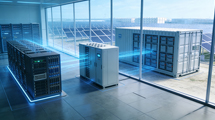
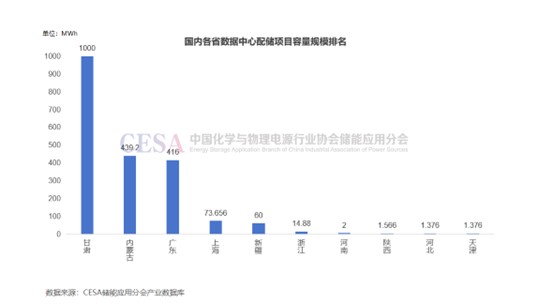
According to statistics from the industry database of the CESA Energy Storage Application Branch, from 2024 to the end of 2025, there were 15 new data center energy storage projects in China, with a grid-connected scale of 398.75MW/2008.92MWh. In terms of construction locations, Gansu added 1GWh of grid-connected capacity, accounting for nearly 50% of the capacity and ranking first nationwide. Inner Mongolia added 109.8MW/439.2MWh of grid-connected capacity, and Guangdong added 208MW/416MWh. In addition, Shanghai, Xinjiang, Zhejiang, and other places also had new projects connected to the grid, with scales of 73.66MWh, 60MWh, and 14.88MWh, respectively.
Why Can't Data Centers in the AI Era Do Without Energy Storage?
The biggest difference between AI data centers and traditional industrial loads lies in their extreme requirements for power supply stability.
For large model training, a single instantaneous power outage or a single voltage fluctuation can cause training tasks lasting several weeks to be interrupted, resulting in huge economic losses. Therefore, the Action Plan specifically proposes encouraging computing power facilities to be equipped with "grid-forming energy storage" to enhance power supply stability and the ability to actively support the power system.
This statement is very critical. In the past, data centers mainly relied on UPS systems and diesel generators as backup power sources. However, as the scale of AI computing power continues to grow, traditional UPS can no longer meet the power quality requirements of future ultra-large AI clusters. In the future, data center energy storage will no longer be merely "backup equipment for power outages," but a new-type power node with the ability to actively support the power grid.
This means that the value system of energy storage is undergoing a fundamental change. In the past, energy storage was more about passively responding to power grid dispatch. In the future, energy storage will directly participate in the operation of computing power systems, undertaking higher-level functions such as voltage support, frequency regulation, inertia response, and black start.
Especially in scenarios with a high proportion of new energy, the importance of grid-forming energy storage is rapidly increasing. Traditional "grid-following energy storage" relies on a stable power grid for operation, but in the future, as the proportion of new energy continues to rise, power grid fluctuations will increase significantly. AI data centers, in turn, precisely require an extremely stable power supply environment. Therefore, energy storage must have the ability to "actively build the power grid." This is also why the Action Plan specifically emphasizes grid-forming energy storage.
From the perspective of the industrial chain, this means that in the future, the focus of competition in the energy storage industry may no longer be merely the cost of battery cells, but rather PCS, EMS, system integration, and energy management capabilities. The companies that truly benefit may not necessarily be only battery manufacturers in the future, but may very likely include more energy storage PCS companies, energy management system companies, virtual power plant platforms, power AI companies, and energy digitalization service providers. In this way, the value chain of the energy storage industry will be redefined.
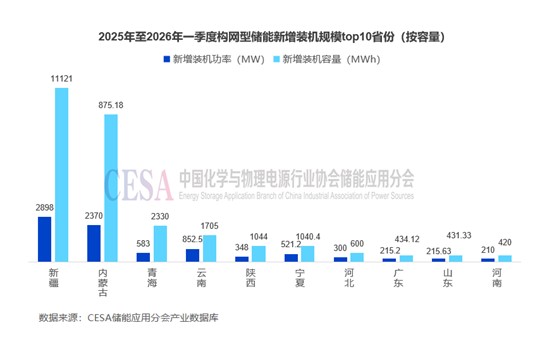
According to statistics from the industry database of the CESA Energy Storage Application Branch, from 2025 to the first quarter of 2026, a total of 87 grid-forming energy storage projects were newly added, with a total scale of 9.19GW/30.05GWh. In terms of construction locations, Xinjiang added 2.9GW/11.12GWh of grid-connected capacity, accounting for 37.01% of the capacity and ranking first nationwide. Inner Mongolia added 2.37GW/9.44GWh of grid-connected capacity, accounting for 31.42% of the capacity and ranking second. Qinghai added 0.58GW/2.33GWh of grid-connected capacity, accounting for 7.75% of the capacity and ranking third. Yunnan, Shaanxi, and Ningxia also saw newly added grid-connected scales reaching the GWh level, at 1.71GWh, 1.044GWh, and 1.04GWh, respectively. By application scenario, the grid side added 7.16GW/23.95GWh of grid-connected capacity, accounting for 79.7% of the capacity; the power source side added 1.83GW/5.73GWh of grid-connected capacity, accounting for 19.07% of the capacity; and the user side added 192.29MW/368.22MWh of grid-connected capacity, accounting for 1.23% of the capacity.
"AI + Energy Storage" May Trigger an Explosion in Long-Duration Energy Storage
It is worth noting that the AI era may also become an important catalyst for the commercialization of long-duration energy storage.
At present, the industry generally believes that long-duration energy storage of more than 4 hours is key to future high-proportion new energy systems, but for a long time, long-duration energy storage has always faced problems such as imperfect revenue mechanisms and unclear business models.
The emergence of AI computing power centers may change this situation. This is because AI data centers have characteristics such as all-weather operation, high stable load, high green electricity demand, and high sensitivity to electricity prices. This means that long-duration energy storage can help computing power centers achieve multiple goals, including smoothing new energy fluctuations, increasing the proportion of green electricity, reducing peak electricity prices, and improving power supply reliability.
In other words, the AI era has for the first time given long-duration energy storage a stable and high-value application scenario.
In the coming years, long-duration energy storage technologies including flow batteries, compressed air energy storage, and hydrogen energy storage may be the first to achieve large-scale deployment in AI energy bases. This means not only an expansion of installed energy storage scale, but also further differentiation of energy storage technology routes.
In the past, the industry competed over "who is cheaper"; in the future, the industry may compete over "who is more stable," "who is more suitable for AI loads," and "who can provide longer-duration support capability." AI will be an important turning point for long-duration energy storage to truly enter the industrialization stage.
Energy Storage Business Models Are Undergoing Fundamental Changes
For a long time, one of the biggest difficulties in the energy storage industry has been the single revenue structure. Many energy storage projects rely heavily on capacity leasing, peak-valley arbitrage, and local subsidies. Once the electricity price mechanism changes, project revenues are easily affected.
However, the Action Plan is actually opening up new business models for energy storage. The policy explicitly proposes promoting computing power facilities to participate in market transactions such as electric energy, ancillary services, and demand response, while encouraging computing power facilities to sign multi-year green electricity trading contracts with renewable energy enterprises.
This means that in the future, AI computing power centers themselves may become a kind of "super flexible load." Some AI tasks are dispatchable and can dynamically adjust operation time according to electricity prices and green electricity supply conditions, while energy storage is responsible for completing electricity buffering and system stability.
In the future, the revenue sources of energy storage projects may likely expand from single peak-valley arbitrage to multiple dimensions, including electricity trading revenue, ancillary service revenue, capacity revenue, green certificate revenue, carbon asset revenue, and computing power stability revenue. It is even possible that a "computing power PPA" model may emerge in the future, in which AI enterprises sign long-term "green electricity + energy storage" agreements with new energy enterprises, similar to the long-term energy procurement agreements currently being promoted by overseas technology giants. Once this model matures, the long-standing problem of cash flow stability that has plagued the energy storage industry may be significantly improved.
AI Reverse-Transforms the Energy System, Energy Storage Enters the "Intelligent Operation Era"
Another core aspect of the Action Plan is not merely that "AI consumes electricity," but that "AI reverse-transforms the energy system." The policy explicitly proposes promoting the development of professional large models in the energy field, including multiple directions such as power grid dispatch, new energy forecasting, electricity trading, equipment operation and maintenance, virtual power plants, coal mine intelligence, and oil and gas intelligence.
Energy storage itself is an extremely complex system. Future large-scale energy storage power stations need to process massive amounts of data in real time, including SOC, SOH, temperature control, electricity price forecasting, load forecasting, and battery life management. Traditional manual operation and maintenance models will certainly be difficult to meet the demand.
The intervention of AI will significantly improve the operating efficiency of energy storage systems. Therefore, in the future, competition in the energy storage industry may move from "hardware manufacturing competition" to "AI operation competition." Whoever possesses stronger data capabilities, algorithm capabilities, and system coordination capabilities will be able to occupy a higher-value position in the future energy storage market.
This means that the energy storage industry is gradually evolving from manufacturing toward "energy technology services."
Conclusion: Building a New-Type Energy System with "Computing Power + Electricity + Energy Storage" Coordination
The significance of this Action Plan is not merely that of an industrial policy. What it truly changes is the underlying logic of China's energy system over the next decade. In the past, the positioning of the energy storage industry was more like an auxiliary tool for new energy development, but in the AI era, energy storage is being upgraded into new-type infrastructure for the digital economy era.